Design Thinking: An Interview with Author Fred Estes
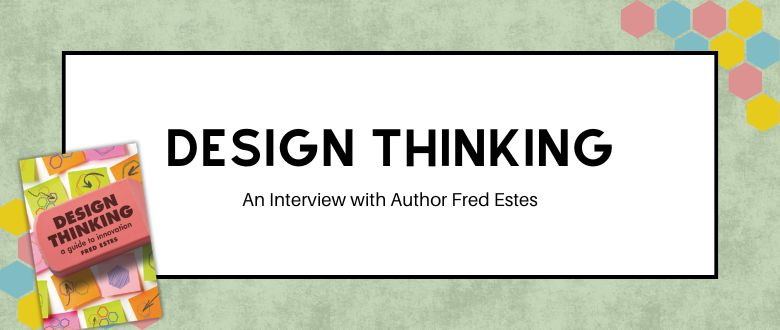
Got a problem that needs solving? All you need is six steps and a little creative thinking. Design Thinking: A Guide to Innovation by Fred Estes is a examines each step—notice and reflect, empathize, define, ideate, prototype, and test—and provides case studies to illustrate how design thinking can create a more human-centered, equitable world.
Today author Fred Estes joins us to share why design thinking is important in the modern world, how he selected which stories and projects would appear in the book, how to use Design Thinking in the classroom, and more!

What inspired you to write this book on design thinking?
My students were my inspiration. Sometimes, my students would tell me that science was cool but that people like them could never do it well. Sometimes, they wanted to know how studying STEM could ever make a difference in their lives. I began looking for stories to share with them to answer these questions. When I couldn’t find what I was looking for, I took Toni Morrison’s advice and wrote the book I wanted to share with them.
Accomplishing this goal actually turned into two books. My first, Teen Innovators: Nine Young People Engineering a Better World with Creative Inventions, explored how these teen trailblazers changed lives through their ingenuity and problem-solving. My latest book, Design Thinking: A Guide to Innovation, demystifies step-by-step the creative process these inventors used. I illustrate each chapter with true stories of inventive teens and the tools and resources you need for design projects. I want my students—and everyone—to see design thinking as both an approach to life and a valuable process.
What is the most surprising thing you discovered while researching or writing this book?
The most surprising discovery was how universally applicable design thinking is, regardless of the subject matter or the age group. From middle school students tackling local environmental issues to high schoolers developing assistive technologies, empathizing, ideating, and iterative prototyping transcends traditional academic disciplines. Many elementary teachers and their students apply design thinking to improve their classrooms and their schools. Research consistently shows that active, hands-on, personally relevant learning is the most effective.
What also surprised me was how integrating design thinking connects students to their communities in meaningful ways, helping them see the relevance of what they’re learning.

Can you share a particularly memorable story or project featured in the book?
There are so many brilliant stories that picking just one is very hard! One student team designed a wearable device to help blind people avoid veering off-course as they walk. We all naturally veer as we walk, though sighted people can easily correct their course visually by looking around. Without this reference ability, blind people risk falling or walking into traffic. This team met a blind man at a community support center who became their partner. Together, they created a smart belt with small vibrating motors on each side of the walker’s waist.
Sensors indicate when a person is veering in one direction and then signal the motor on that side to vibrate, telling the walker to turn more in the opposite direction. This technology is especially useful in noisy and crowded public places where navigation by sound is not safe. Extensive testing confirmed its effectiveness. The smart belt won several design and invention awards, and some team members started a company to bring this smart belt to more people. Even more importantly, their community partner is delighted with his smart belt and can now confidently walk the streets.
How does your book differ from other books on design thinking?
While many good books on design thinking focus on theory or business applications, my book highlights young innovators and the real-world problems they are solving. As the story example above shows, there is also a particular emphasis on design projects to help others or improve the local community. I expanded the traditional design thinking model to include reflection and self-examination prior to engaging with the community with a need. This reflective step comes from the playbook of community organizing methods.
This book explains step-by-step the design thinking process, complete with diagrams, templates, and tools. Each chapter showcases a true story of how real students use these skills to make meaningful contributions to their communities and the world.
How did you select the students and projects featured in the book?
A good handbook needs good examples. Each chapter of Design Thinking: A Guide to Innovation has true stories of actual student projects to illustrate the key ideas. Project Invent staff helped me identify some student teams and their mentor teachers to interview. These interviews were a wonderful opportunity to explore how the design thinking process works in action. The experiences of these students became the core of the book.

Why is design thinking important today?
In a rapidly changing world, the ability to think creatively and solve complex problems collaboratively is more critical than ever. Design thinking provides a framework for building both confidence and competence. Teaching design thinking equips the next generation to tackle challenges ranging from global issues like climate change to addressing local community needs. It’s a way to turn curiosity into action and ideas into impact.
What challenges did you face while writing this book?
Finding the right balance of student stories and design thinking tools, yet keeping the book compact and practical, was surprisingly hard. Should I add this story? Should I show that tool? Eventually, I realized my website could serve as a platform to keep the book updated with new tools and additional stories. My blog Stem and Creative Change (fredestes.com) publishes stories of young or overlooked scientists and inventors, STEM book reviews, STEM projects for home or school, and my reflections on new STEM discoveries and developments.
What advice would you give to educators looking to implement design thinking in their classrooms?
Start small and use a design thinking project to extend and enrich a curricular unit. For example, in a social studies unit, student teams might design solutions to a community problem you studied, such as a neglected community park. For STEM classes, there are many engineering challenges and contests readily available.
Focus on building a culture of empathy and creativity. Design thinking doesn’t have to be a massive undertaking—it can begin with simple projects that encourage students to understand the needs of others and brainstorm solutions. Encourage experimentation and create a place where it is safe to make mistakes, where mistakes are celebrated as discovery. Collaborate with students, be open to experimentation, and most importantly, make the process as much about having active fun learning as the final product.
What do you hope readers will take away from your book?
I want readers to see that design thinking is not just for designers or professionals—it’s a powerful framework that anyone can use to tackle complex challenges. When combined with project-based learning, design thinking becomes an especially effective tool for students, allowing them to create active, practical, and relevant solutions. I want readers to feel inspired to bring design thinking into their own work, whether in school, in their neighborhoods, or in their personal lives.
What’s next for you? Are there any future projects or books in the works?
I’m currently exploring how design thinking acts beyond the classroom to create meaningful, self-sustaining social change. My next project focuses on how changemakers—both young and old—can design and organize for long-term social impact. By addressing questions like how innovations move out into neighborhoods and broader communities, I aim to highlight the intersection of design thinking and social entrepreneurship. This new book will show how we can all harness design thinking to solve problems and create solutions that endure and enable others. Everyone can be a changemaker capable of designing a better future, one project at a time.

Praise for Design Thinking
“Ideal for teens, educators, and community leaders who want to inspire youth to apply design thinking in creating real-world solutions. The writing motivates readers to reflect on their own ideas with examples that make the concepts relatable. . . What distinguishes this book is its focus on practical, real-world applications.”—starred, School Library Journal
“An inviting book to help readers get into the headspace of innovation and set them up for success.” — Booklist
“With clear organization and a focus on fostering growth and action, this guide to the design thinking process offers much to young innovators and the educators who empower them. . . Veteran educator Estes encourages a positive mindset built on empathy, collaboration, curiosity, and openness to differences that enhances learning and growth in all settings.” — Kirkus Reviews
Connect with the Author

Fred Estes taught science for nearly two decades in a school near his home in San Francisco. He’s written several articles about science teaching, including “Compost: The Rot Thing for Our Earth” and he is a peer reviewer for a National Science Teaching Association journal. Before that, he taught high school English, worked as a financial analyst, joined an AI startup, developed corporate training programs, and earned a doctorate in educational psychology and technology. Currently, he teaches graduate students and teachers about design thinking, innovation, creative teaching methods, and hands-on-STEM curriculum.


Comments