Sometimes the Girl: An Interview with Jennifer Mason-Black
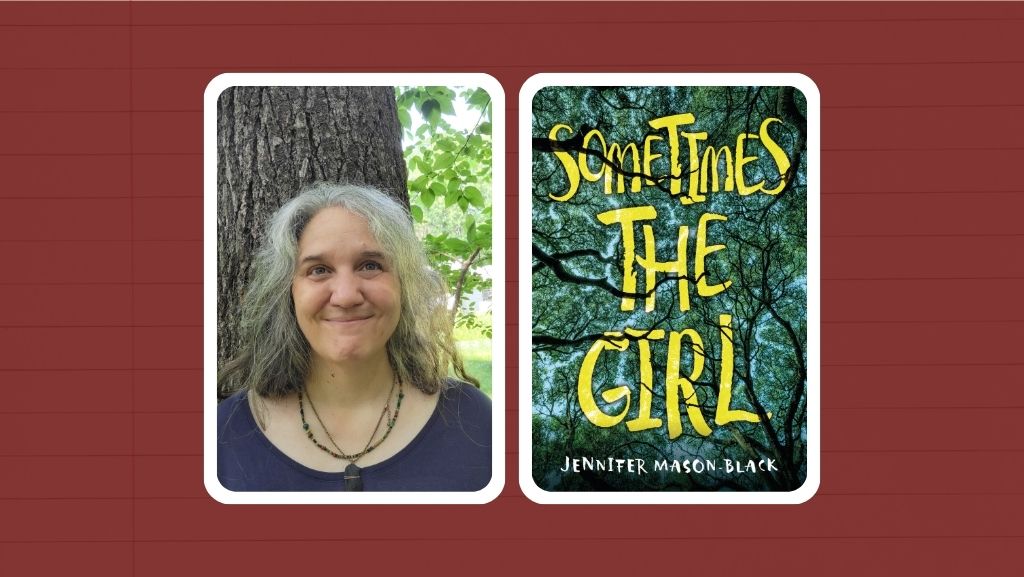
What do relationships, art, and the truth have in common? Sometimes they are messy. Eighteen-year-old Holi learns this firsthand in Sometimes the Girl when she gets a short-term job sorting through the attic of an acclaimed elderly author. There in the attic, Holi discovers secrets that change the way she sees her own life and writing as she grapples with choices that will redefine her own path.
Today author Jennifer Mason-Black shares her story as a writer, backgrounds behind her characters, and more. Read on to download the free discussion guide!

Hi, Jennifer! Can you tell us a bit about yourself?
Sure! I’m Jen (she/her) and I live in Massachusetts. I’ve been here almost all my life, aside from time in Maine when I was a baby. I was homeschooled until I was twelve and I homeschooled my own kids to age eighteen, so I’ve spent a lot of time thinking about how people learn. I’ve worked all sorts of jobs, including research in commercial apple orchards that required me to count dead bugs on sticky traps all summer long. Weirdly enough, I loved it! These days I mostly write and keep a log of insects and plants around my house (outside, not inside). Strange fact: I have hundreds and hundreds of photos of bumblebees on my phone and very few of my family.
Did you always want to be a writer?
No…? I mean, I wrote my share of stories as a kid and more than enough poetry in my teens and twenties. However, I’ve wanted to be a lot of things: an astronaut, a veterinarian, a librarian, a speechwriter…I won’t bore you with the whole list!
Those things have mostly been jobs, careers I thought I’d like to have. Writing has been more about living—on the deep-within level while also on the galactic. We only get to travel through this life once. When I write, I can cheat and experience so many more, those I wish I’d had and those I feared and those that I want for the people I love. I’ve always had space in my heart that exists solely for writing, but its door opens and closes on an unpredictable schedule.
Do you wish you could live the lives of the characters you write?
Ah, I left something out. For me, half of writing is about taking paths I missed when I chose others. I do it because they’re fabulous, because I’m greedy, because of a thousand reasons. But the other half is why I write melancholy things, sad things. I’ve dealt with lots of depression and anxiety in my life; I know about the sad and the melancholy and the scary. I’d love to say I put these elements in my stories to help others survive them, but the truth is that I write them for myself. To remind myself that it’s possible to pass through the tough places and find goodness on the other side. Or even to find it in a tough place: good people exist, moments of utter awe and little bits of cheer lurk everywhere. Growth happens. So it’s not the heartache I want to experience, but the compassion that helps us through it.
Your new book, Sometimes the Girl, is out now. What can you tell us about it?
Sometimes the Girl is so many things to me. On the most basic level, it’s the story of Holiday, an eighteen-year-old young woman who’s struggling. Within two years, her girlfriend has dumped her, someone she loved has died unexpectedly, and her beloved brother has attempted suicide. She’s even lost her connection to writing, the thing that held her together. Holi is adrift. To make money for a cross-globe trip with her ex, she takes a job working for Elsie McAllister. Elsie’s a prickly, staunchly private writer in her nineties who published a single brilliant book many decades ago and then quit. And Holi’s job is to organize her attic, which is stuffed to the gills. There are so many boxes and labels in this book! I have no storage space in my house—none!—so I obsessed over what Elsie could keep in hers.
It’s more than just boxes and labels, right?
Hopefully! Sorting through Elsie’s boxes forces Holi to confront the contents of her own emotional attic and the assumptions she’s made about others, about herself, about storytelling. She’s longing for her ex and what they had, and maybe for a beautiful young woman passing through town, and for her brother to somehow return to the person he used to be. There’s a rave, an unexpected night with her favorite band, her best friend’s baked goods, incorrect academic theories, porcupines under abandoned apple trees, and my own love of the places where I grew up and still live. It’s about all the things, all of them (whispers every author ever about their current book)!
Are any of the characters based on real people?
For the most part, no. I don’t like to write characters based on people I know, because if I like them, I’d rather just spend time with them, and if I don’t like them, why would I want to give them room in my writing? Elsie McAllister exists because I was interested in how people responded to Harper Lee’s release of a second book late in her life, but Elsie is utterly her own person. I know very little about Harper Lee’s life; I know everything about Elsie’s.
I’d be a liar, though, if I said that no flesh and blood people made it into Sometimes the Girl. Mouse—Holi’s forever friend—exists because someone I love was going through a tough time and so I wrote a book for her. In that book was a character based on her so I could show her how awesome she was. That character was Mouse, who also appears in Sometimes the Girl because I’m now very attached to her.
Is there anything more you’d like to say?
So much! About writing, about life, about everything! But that’s kind of the point of writing books—they’re bigger than interviews and easier to cram lots of thoughts and feelings and ideas into. Let’s leave it at this: save turtles on the road whenever you can; read lots of books about all sorts of things; touch the bark of trees as you pass them; be in love with the earth and with other people and with yourself.
Praise for Sometimes the Girl
★ “A touching coming-of-age novel about healing and connection. Holi’s story models radical empathy, and its conclusion acknowledges that language is the only tool that may bridge the gap between people who seek to understand each other.” — starred, Foreword Reviews
★ “Mason-Black’s prose sparkles with poetic beauty as Holi engages in introspective musings about collective mourning and how individual healing is possible only in community. . . This striking work shows the power of intergenerational relationships to fortify queer artists against erasure . . . Beautifully written and powerfully uplifting.” — starred, Kirkus Reviews
“Mason-Black’s writing, expressed through Holi’s first-person narration, is original and striking in its depth, putting a thoughtful spotlight on Holi and the people around her. An appealing and engrossing work.” — Booklist
“A powerful, lyrical story that honors creativity, queerness, healing and intergenerational relationships.” — Ms. Magazine
Free Educator Resources
Sometimes the Girl is a thought-provoking and poetically crafted coming-of-age story. Give young adult readers a boost in their critical thinking and comprehension with this free discussion guide.
And to hear more from Jennifer on creativity and art, read her post from Teen Librarian Toolbox!
Connect with Jennifer

Jennifer Mason-Black is the author of Devil and the Bluebird (Abrams 2016), which received starred reviews from Kirkus, Publishers Weekly, and Shelf Awareness, and was included in the Locus Recommended Reading List 2016. Her short fiction has appeared in Strange Horizons, Fireside Fiction, Daily Science Fiction, and The Sun, among others. She is a member of SFWA and the Author’s Guild, and lives deep in the woods of Massachusetts.

Comments