Stokes: An Interview with Authors Ty Chapman and John Coy
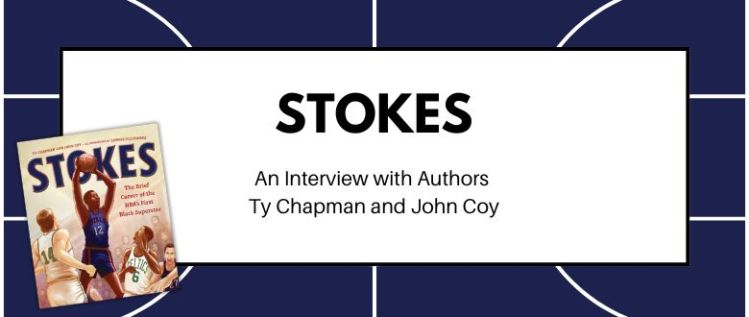
He shoots! He scores! Maurice Stokes was 6’7″ and could play offense and defense like no one else his size in the NBA in 1958. After experiencing a career-ending injury during a game, other players rallied to support him. Stokes: The Brief Career of the NBA’s First Black Superstar is the first picture book to chronicle his life and career.
Today authors Ty Chapman and John Coy join us to share how they collaborated to write this picture book biography and the most surprising parts of their research. Read on to download the free teaching guide to accompany the text.

How did this collaboration come about?
Ty Chapman (TC): Back in 2020—before I had penned my debut picture book, Sarah Rising—I was having a hard time figuring out how to thoughtfully write about a topic like protest for such a young age. I attended a virtual panel on writing picture books with difficult themes. At the time a total stranger to me, John Coy was one of the panelists. He was discussing his book IF WE WERE GONE, which speaks to the climate crisis and human extinction in a gentle, accessible way. I still feel lucky to have a signed copy of my bookshelf.
During the Q+A, I mentioned I was writing a picture book influenced by the Uprising that followed the murder of George Floyd, and asked if the authors had any comp titles. John encouraged me to reach out to him via email, and we’ve been fast friends ever since.
John has been a friend and mentor to me throughout the entirety of my career. We quickly bonded about our love of kidlit and basketball. I forgave him for being a Lakers fan, and he shows me continued grace for switching teams every time James Harden gets traded. Given our mutual interests, some manner of basketball collaboration felt like an inevitability. So, when John told me he had a picture book idea about a historically great basketball player that no one seemed to know about, I was all in.
John Coy (JC): Ty called me to talk about writing basketball picture books since I’ve written Hoop Genius, Game Changer, Strong to the Hoop, and Around the World. The more we talked, the more I liked his energy and what he was saying. That’s when I asked if he’d like to collaborate on a basketball picture book about Maurice Stokes.
What did that collaboration look like in practice? How did you both write a book with so few words?
TC: This was an extremely interesting process, and a first for me at the time. From the beginning of our friendship, John and I would go on long walks around the Twin Cities. We’d discuss everything: personal matters, the industry, how our books on submission were progressing, the highs and lows of drafting, and even run half-baked ideas by one another. To this day, we always wrap up our walks by discussing the NBA season.
When John and I began work on Stokes, we dedicated a good portion of our multiple-hour walks to discussing the legacy of Stokes, craft, and how to weave two distinct authorial voices together.
Once we’d established a shared vision and gameplan, we’d go our separate ways and write our own versions of the manuscript. Then we’d go on another walk and define our vision for edits. We’d take the different themes and language of the two drafts and splice the best parts together, creating a sort of frankenscript. We rinsed and repeated this process until we arrived at a coherent manuscript with a single authorial voice.
Because of John’s genuine love for collaboration, and my experience with it as a former theater-maker and puppeteer, it was a smooth process from start to finish.
JC: We talked about the story, helped each other with research, and then wrote separately. Then we’d meet via Zoom to discuss what we’d both written and then put together what we liked best. We also took a lot of long walks talking about details of the story and how we wanted to tell it.

What is the most surprising thing you discovered while researching or writing the book?
TC: When John asked me to collaborate on this project, I had no idea who Maurice Stokes was. Despite being an avid hoops fan, and having a solid knowledge of the NBA’s history, Stokes was an incredible player whose story I had never heard. In many ways, Stokes was a LeBron James type of player long before LeBron James was born—he was a big man who could pass, rebound, and score extremely well. When John clued me into the greatness of Stokes, and the beautiful community that stepped up to help pay for his care after his injury, I fell in love with the story just as he had.
JC: How many huge basketball fans don’t know anything about Maurice Stokes even though he was one of the best players to ever play in the NBA and helped create the modern game. It was much better known sixty years ago, but it hasn’t been passed down to new generations of basketball fans. Maurice Stokes was an amazing player and person and we want to do all that we can to share his story.
What do you hope readers will learn or discover from reading your book?
TC: I’d just love for folks to have more knowledge around Stokes’s story. I think it’s a shame that even some of the most knowledgeable fans don’t know about him. If he never hit his head in that game vs the Minneapolis Lakers, Maurice Stokes would absolutely be in conversations among the other greats of his era, like Bill Russell and Wilt Chamberlain.
I also hope the community-centric aspect of this story resonates with folks. So often, western culture is fixated on individualism, and the accomplishments of a single person. While Stokes’s greatness is a key pillar of this story, so too is the NBA community that rallied around a friend to help pay for his care. I think that idea of creating a substantial change via community action, even if it simply changes one life, is so important to center these days. That particular aspect of Stokes’s legacy is a learning opportunity for children and adults, alike.
Praise for Stokes
“Telling a moving story, Chapman and Coy introduce Stokes’ unusual combination of size, skills, quickness, and understanding of the game and then explain how differently Black players were treated on NBA teams in the 1950s. From action scenes to quiet moments, Ollivierre’s art illustrates the narrative with empathy and style.” — Booklist
“A poignant might have been, worth remembering and still as cogent as ever.” — Kirkus Reviews
“Vivid writing pairs with vibrant illustrations to depict a tragic but fascinating look at an engaging and exciting player whose misfortune, sadly, changed the way that basketball is played forever.” — School Library Journal
Free Educator Guide
Download the free educator guide to learning beyond the page!
Connect with the Authors

Ty Chapman is the author of Sarah Rising (Beaming 2022); Looking for Happy (Beaming 2023); A Door Made for Me, written with Tyler Merritt (WorthyKids 2022); as well as multiple forthcoming children’s books through various publishers, and a forthcoming poetry collection through Button Poetry. Ty was a finalist for Tin House’s 2022 Fall Residency, Button Poetry’s 2020 Chapbook Contest, and Frontier Magazine’s New Voices Contest. He was recently named a Cave Canem fellow and holds an MFA in creative writing from Vermont College of Fine Arts.

John Coy is the author of young adult novels, the 4 for 4 middle-grade series, and nonfiction and fiction picture books including Hoop Genius, Game Changer, Their Great Gift, Dads, If We Were Gone, and Where We Come From. He has received numerous awards for his work including a Marion Vannett Ridgway Award, a Charlotte Zolotow Honor, a Bank Street College Best Book of the Year, and the Burr/Warzalla Award for Distinguished Achievement in Children’s Literature. John lives by the Mississippi River in Minneapolis.
Can’t get enough of Lerner authors? Neither can we! Read more of their interviews on the Lerner blog here.

Comments