Ultrawild: An Interview with Author Steve Mushin
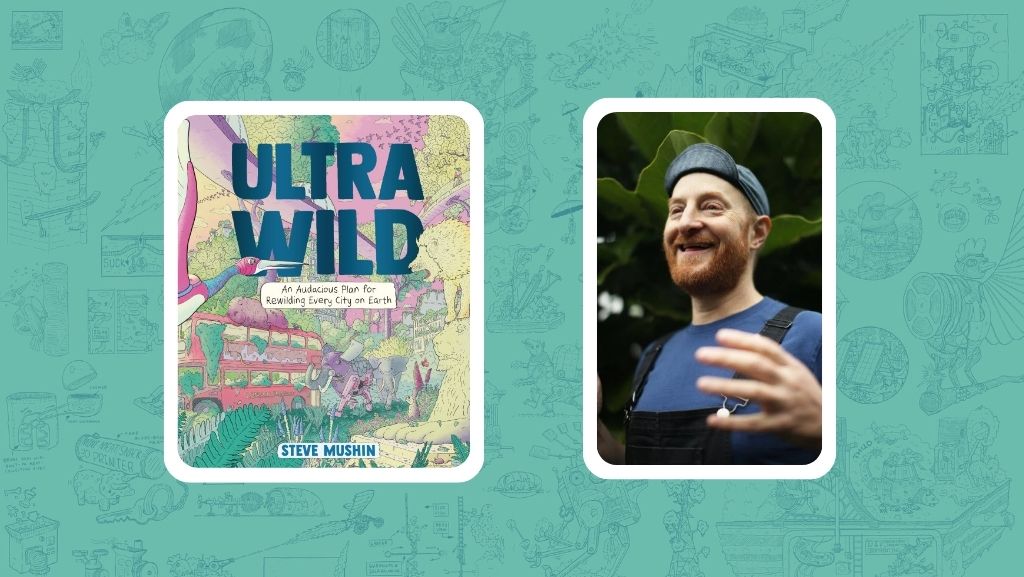
What if submarines could filter sewer water? What if compost cannons could blast seed bombs over half a mile? Ultrawild: An Audacious Plan for Rewilding Every City on Earth takes readers through an avalanche of scientifically plausible inventions to fight climate change, rewild cities, and save the planet. Maverick inventor Steve Mushin creates a tour de force of extreme problem-solving for kids and teens (and anyone else) who love big ideas and want to save the world.
Today Steve joins us to share some of the coolest invention ideas in Ultrawild as well as some of the things he has learned while creating the book. Read on to find sneak peeks, interviews with Fanbase Press, and more!

What are the wildest things readers will learn from Ultrawild?
The first ultrawild thing:
Flying bicycles powered by your legs are technically possible. Soon we’ll all be riding them. But first we’ll need ultrathermals – massive cones above cities that collect waste heat for launching flying bikes into the sky. Three blocks of New York City could give us enough waste heat to blast flying bikes miles high – so we can glide wherever we want.
Flying bikes would mean a lot less cars, roads and parking lots in cities, freeing up vast areas of city land for trees and animals. This is extreme city rewilding. Or as I say – ultrawilding! Once we quit fossil fuels, ultrawilding will be one of the greatest tools we have to reverse climate change. And it’s heaps of fun too – who wouldn’t want to live in a high-tech jungle?
The second ultrawild thing:
The world’s 2.5 billion street lights, power poles, traffic lights and street signs are ‘nearly trees’ – they’re perfect for 3D-printing into luxury habitats for animals. We’ll need to 3D print these ‘nearly trees’ as fast as possible to house the billions of animals and insects we need to welcome back to help ultrawild cities – for pollination, seed dispersal and soil fertilizing. And to do THAT we’ll need a trillion or so 3D printer birds. This is totally possible.
3D printer birds are flying tree-printing robots. They first 3D scan trees – to map all their hollows and other animal habitat features. Then they 3D print lampposts and other ‘nearly trees’ into fake trees that are perfect animal homes. 3D printer birds print using recycled plastic which they melt by concentrating heat from the sun using mirrors on their wings. They can also 3D print copies of themselves, or self-replicate. It would take roughly ten months for 3D printer birds to multiply to one trillion – if we started with just one self-replicating 3D printer bird today. And it would take 1000 3D printer birds roughly one month to transform a LA lamppost into an fake-oak-tree-super-habitat for real birds.
The third ultrawild thing:
According to experts, chickens have dreams, do basic math, and can solve simple problems by anticipating future events. They’re also the perfect soil-making engineers to help us transform the world’s roughly 2 billion roofs into vertical gardens. Even better, according to the latest science, chicken poo is perfect for growing algae, which can be used to make bioplastics for 3D printing almost anything – like rooftop gardens with luxury chicken castles.
Here’s the plan: humans must collaborate with the world’s 33 billion chickens to transform every building on earth into a vertical jungle. All we need to do is give chickens their freedom, all world’s roofs to live on, and all our food scraps (launched up to them using compost catapults, or ‘compostapults’). Chickens could then technically transform the world’s 2 billion roofs into jungles in just a few years (with the help of chicken-poo-collecting-robot-beetles, algae-plastic making-bioreactors, and 3D printer chickens).

What have you learned from writing Ultrawild that has surprised you?
It’s probably as difficult for us to imagine how quickly humans could repair the planet…as it would have been for our ancestors to have imagined how quickly humans would trash the planet.
While working on Ultrawild – talking to scientists and researchingengineering innovations from around the world – I was constantly amazed by the incredible potential of so many new technologies to rapidly transform our world for the better.
Think about shared autonomous vehicles. Cities are 30-60% covered with roads and carparks. But if, as some transport engineers predict is possible, shared autonomous cars could reduce total cars by 80%, and remove most parking, we could double the amount of space an average city has for people, and turbocharge ultrawilding.
Consider the possibilities of algae bioplastics. These future super-materials can be mixed with natural fibers for carbon-fiber-like strength – perfect for 3D printing flying bikes, luxury animal habitats and skyscraper gardens. They’re biodegradable too. And they could be made almost anywhere in the world to replace today’s petrochemical plastics. Even better, their production sucks down, or sequesters, vast amounts of carbon from the air.
Then there’s microbial-based foods which have the potential to completely transform global food production. Solar Foods in Finland has developed a bacteria-based protein that can be produced using 20,000 times less land than regular farming, while requiring only air, water and solar electricity as inputs. It can be made into super-realistic fake meats, eggs, milk, and more – potentially freeing up much of the world’s farmland for rewilding.
I’m ultra excited about the potential for radical innovation to help us quit fossil fuels super-fast. To transform cities into habitats for all species. And to start reversing climate change and biodiversity loss now.
We just need the courage to imagine the possibilities.

Sneak Peeks and More
Boing Boing: “an invitation to face climate change with creativity, humor, and a spirit of can-do problem-solving.”
Conskipper Interview: “While Ultrawild is ostensibly a book about inventions, the real story is rewilding. Rewilding is an incredibly powerful concept that can massively boost biodiversity and absorb vast amounts of carbon.”
Fanbase Press Interview: “Brainstorming wild ideas with scientists and engineers is what I love – and every collaboration has been different.”
Graphic Policy Exclusive Preview: “To make leaps of innovation we have to explore ideas that initially seem preposterous. Even as we’re bombarded by headlines about the destruction of nature, massive rewilding projects are rebuilding ecosystems faster than most people believe is possible.”
Praise for Ultrawild
★”Each page is filled to the brim with meticulously drawn cityscapes, mechanical designs, animals of all shapes and sizes, and lengthy text explanations. . . Ultrawild is a brilliantly designed comic that will have wide appeal beyond its target audience, even for adults.”—starred, Booklist
★”An essential addition to middle and high school libraries, this graphic novel is a green how-to manual for 2025.”—starred, School Library Journal
“Silly fun with a serious purpose.”—Kirkus Reviews
“This densely packed and hilarious graphic novel about the power of rewilding to fight climate change should delight science-minded kids who love informational, humorous books.”—Shelf Awareness
“Like a futuristic Where’s Waldo for the inner scientist in all of us, Ultrawild is a fantastic read. It manages to be both a dazzling art book and a manifesto for radical thinking, reminding us that solutions to the climate crisis may only come if we allow imagination to guide our understanding of science. Mushin’s work is about proving that dreaming outrageously might be the first step toward surviving the future.”—AIPT Comics
“A humorous, thought-provoking blueprint for a better future… It’s easy to be pessimistic about the future, what with climate change and a host of other problems hanging over civilization’s head. But with his new book Ultrawild: An Audacious Plan for Rewilding Every City on Earth, inventor Steve Mushin aims to present a series of hilarious yet oddly plausible solutions to society’s woes.”—IGN
Connect with the author

Steve Mushin is an industrial designer, artist, and inventor who collaborates with scientists and engineers to solve perplexing problems. Steve has exhibited large-scale design drawings and models around Australia and in Japan. He works between Australia and Aotearoa New Zealand. He has won several awards for his work including the British Council’s Big Green Idea Award and an Australian Design Honours award for his work in sustainable futures thinking. Ultrawild is Steve’s debut book.


Comments