Skip to content

Author Interviews

Book icon
Author Interviews

Photographer Wing Young Huie Interviews Author John Coy

Today, John Coy and Wing Young Huie, the author and photographer team behind Their Great Gift: Courage, Sacrifice, and Hope in a New Land, take over the blog again! Their Great Gift has received three starred reviews from Kirkus ReviewsSchool Library Journal, and Publishers Weekly. In this post, Wing interviews John. To read John’s interview of Wing from last week, click here.


Wing: What was it like for you to work with a photographer rather than an illustrator?

John: This was the first time I’d ever worked directly with the artist. Normally that’s kept completely separate in picture books and I see the art at the end. For this book, we collaborated together each step of the way. It was a completely new process for me and your ideas and insights on the text made the book so much better. I had your photographs in mind when I was writing and that was really exciting because I knew this book was going to be different from anything I’d done.

Wing: What are the challenges of writing a story that will accompany photos of real people?

John: In the beginning, I focused on my family stories. I’d heard and read so much about what it was like to leave family and country behind and I wanted to get those strong emotions into spare and simple sentences. I knew how powerful your photographs are and from the beginning I wanted the text to be concise so readers would be drawn to the people pictured. As you made suggestions on text and I revised it, I felt the book was opening up to include more and more people.

Wing: How is this different from your other books: subject-wise and process-wise?

John: It’s a very different process. Usually I send a story to a publisher and if they say they want to publish it, they pick the illustrator. This is somebody I’ve never met who lives far away and we don’t talk or communicate while they create pictures. I was so excited to be included in all the meetings with Lerner editors and designers to discuss design, layout, colors, and covers because I’ve never been part of that.

A spread from Their Great Gift

Wing: Where do your ideas for a book start?

John: They usually start with something personal, something I’ve been thinking about for a long time that won’t let go. In writing about it and rewriting and revising it and talking with others, I begin to feel and understand it differently.

Wing: How much do the books differ from the original idea?

John: Normally, the book looks totally different because I don’t know what the illustrator will create. It often looks better than I imagined, but it’s always totally different. With Their Great Gift, however, I always imagined it looking like a Wing Young Huie book. I wasn’t exactly sure what that would be, but now that we have finished books, I feel it looks just like that, better even than I could have imagined.

Wing: What’s your favorite part of making a book?

Gilberto and Their Great Gift
in the early stages of printing

John: Because it takes so long to make a book, I’ve learned how important it is to appreciate and celebrate each step of the process as we get closer to having a book. If I had to pick one part, though, I’d choose the day that the text is accepted and I hear we’re going to make a book. So much is possible at that point. We know we’ll have a book, but we don’t know what it will look like. And the day the box of finished books arrive at my house is pretty great, too.


Wing: What was it like for you to see the actual books being made? [John and Wing visited our bindery to see the book being bound a few months ago!]

John: Amazing. That is something I’ve always wanted to do because students often ask detailed questions about the process. To be there with you to see pages rolling down the line and covers being attached and to know they were all Their Great Gift was truly incredible.


Wing: What was it like to be handed a copy off the line?

John: One of the coolest things ever.

Wing: Would you like to make another book together?

John: Absolutely!

Pick up Their Great Gift: Courage, Sacrifice, and Hope in a New Land at your local bookstore or library today!
Book icon
Author Interviews

Author John Coy Interviews Photographer Wing Young Huie

Today, John Coy and Wing Young Huie, the author and photographer team behind Their Great Gift: Courage, Sacrifice, and Hope in a New Land, take over the blog! Their Great Gift has received starred reviews from Kirkus Reviews, School Library Journal, and Publishers WeeklyIn this post, John interviews Wing, and in next week’s post Wing will interview John.


John: Let’s start with an easy one. What’s your memory of the two of us meeting?

Wing: I remember meeting playing pick up basketball at Bally Total Fitness sometime in the 80s. There were two courts that were informally known as the A and B courts and the best players played on A. We met on the B court. There were times, though, when we stepped up to the A court. Then I started playing with another basketball group that rented a church and invited you to play, which is still going some twenty years later. I think we’ve moved up to A court level!

John: You’ve made a number of books for adults. What was your first reaction to creating a book for children?

Wing: Well, I’m always up for something new. I don’t have children myself but have worked with schools of all grade levels quite a bit, using my photographs and photographic process of approaching strangers to learn about visual literacy and cultural assumptions. So doing a book especially for students is exciting. 

John: What did you think when you saw the first draft of the text for Their Great Gift?

Wing: It evoked a lot of emotions for me, as everyone in my family, my five siblings and both parents, emigrated from China while I, the youngest, was born in Duluth. 

John and Wing
John: What was it like to read the text and then make suggestions on changes to the text?

Wing: I’ve never worked with a writer before on a book. For all my five books the text was written by me and included direct quotes from the people in the photographs. So the challenge for this was to have the text nuanced and complex to open the possible interpretations of the photos and the people in them. You were gracious in allowing me to make suggestions. 
John: When you were selecting photographs, did you immediately have some in mind that you wanted for this book?
Wing: No. I combed through my extensive archive of thousands of images from over 30 years and selected about 150 photos and finally winnowed them down to the 66 in the book. 
John: Since you have thousands of photographs to choose from, what process did you use for selecting the ones for Their Great Gift
Wing: The old-fashioned way. I looked at contact sheets with a magnifying loupe. All of the photos in the book were taken with film, which were processed in a darkroom (most of them by me) and then “contact” printed with a roll of 36 images on one sheet of 8×10 inch photographic paper. We didn’t call them thumbnails back then. 
John: How did you decide between black and white and color photographs?
Wing: I was aiming for a balance of the two but not a specific ratio. Most of my early and middle work is b&w so it ended up about a third of the book is in color.
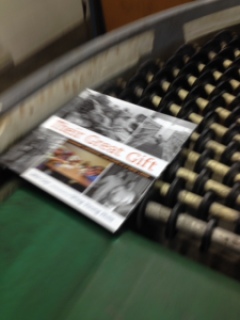
Hot off the presses!
John: What was it like to go to Muscle Bound Bindery [Lerner’s company bindery] and see the book being made right before you? What did if feel like to be handed a copy of Their Great Gift right off the line?
Wing: Definitely a memorable day going there with you and seeing the fruition of our efforts! As I said I am not a parent, but this is the closest I get!
John: I’ve saved the most important question for last. Would you like to make another book together?

Wing: Absolutely!
Thanks, John and Wing! Come back next week to read Wing interview John.
Book icon
Author Interviews

Pioneer Trina Robbins Interviewed in Popular Comic Book Website

One of Graphic Universe’s most acclaimed writers—Trina Robbins—author of the popular Chicagoland Detective Agency series and the highly praised single title Lily Renée, Escape Artist—was recently interviewed by the esteemed comic book website CBR (Comic Book Resources). Interview. CBR, a pillar in the comic book community, has numerous awards to their credit, including a 2011 Eisner Award for “Best Comics-Related Periodical/Journalism” and an Eagle Award in the UK for “Favourite Comics-Related Website”, also in 2011.

The noteworthy and informative interview covers Ms. Robbins fascinating career—spanning over 40 years—as both an author/illustrator as well as a consummate historian. Ms. Robbins is as well-versed in the Golden Age of comics of the 1940s as she is in the underground movement of the 1960s and early 70s, of which she helped pioneer.

In the interview Ms. Robbins touches on such varied topics as her nostalgia for Golden Age publishers like Fiction House to her recent collaboration with illustrator Anne Timmons for the Lily Renée book.

When it comes to all things comic book there are few with as much knowledge and passion as Ms. Robbins and this interview is a must read for anyone with even a hint of interest in the colorful and ever captivating field.

Book icon
Author Interviews

Interview with Elaine Landau, Author of My Favorite Horses

9780761365341fc Following up on last Friday’s post about My Favorite Horses (cover pictured, left), I interviewed the series’ author, Elaine Landau, about her experience in working on the books. Here’s the interview!

What was your favorite part about working on My Favorite Horses?
I really loved working on this series, so it’s hard to pick just one favorite part. But if I have to choose, I’d say my favorite part was working on the sections about horse history. Learning how the various breeds got their start was fascinating, and it was fun to see the different roles these horses played throughout history. I loved sharing what I learned with young readers!

Were you horse crazy as a kid?
I was definitely a horse-crazy kid, and I know that I had lots of company in this area. As a child, my family lived within walking distance of a stable. My parents were good friends with the owners, and my sister and I were allowed to visit and ride the horses often. On those days, we felt like the luckiest kids in the world!

Do you have a favorite breed after researching so many for My Favorite Horses?
I must admit that as I worked on the different books, I fell hopelessly in love with all these fabulous animals. However, I think my favorite horse is the Morgan horse. Besides being beautiful, this horse played an important role in our nation’s history and growth. When the early settlers headed West, the Morgan horse was often used in wagon trains. Morgan horses also carried miners West during the 1848 Gold Rush.

What advice would you give to a horse-crazy kid who can’t get a horse of his or her own?
The best advice I can offer a young horse lover is to not give up on your passion for horses. Know that you’re not alone. In most families, it’s easier to get a hamster than a horse. Though beautiful and lots of fun, horses are costly and need a great deal of care. If possible, try to take riding lessons and ride as often as you can. Also, read up on horses and check out the many horse flicks available. Try to learn more about horses from people who own them as well. Horses are terrific. It’s easy to be drawn to these amazing animals.

Book icon
Author Interviews

Bigfoot Interviews

An alien, a sea monster, and a bigfoot walked into a bar . . . and then they interviewed GU author Colleen Af Venable. Except for the part about the bar. No joke, you can read the whole thing on Bigfoot Reads. This hilarious interview sheds new light on Colleen’s relationship with the mystery genre, puns, and Kit Kat bars (SPOILER: she likes all three!).

Bigfoot has a passion for photography, but his photos always come out blurry.

Book icon
Author Interviews

Exclusive Interview with Three Worms

What to Expect When You’re Expecting Larvae: A Guide for Insect Parents (and Curious Kids), ill. by Stéphane Jorisch, comes out this month. In the book, insect parents-to-be ask questions of the narrator. Here, author Bridget Heos turns the table, interviewing a silkworm, a waxworm, and a real worm—a night crawler.

Bridget: Thank you all for talking to me this morning. Let’s start with the basics. Silkworm, describe a typical day.

Silkworm: Typical. Ha! That’s hilarious. No, every day is so different. One day, I might spend the whole day eating a leaf. And the next day, I eat a different leaf. Then the following day: a new leaf!

silkworm Bridget: It sounds like you spend most the day eating.

Silkworm: No, not most the day. The WHOLE day. If you read the book—

Bridget: I, uh, wrote the book.

Silkworm: Then you must know that we larvae can multiply our weight by 10,000. If a human baby grew that fast, it would soon weigh as much as 7 elephants!

Bridget: I’m glad you enjoyed that passage. How about you, waxworm? What do you do all day?

Waxworm: In the wild, I invade beehives and eat the bees’ wax.

waxwormBridget: Which is how you got your name.

Waxworm: Yes, that’s right.

Bridget: Waxworm is named for what he eats. What about you, Silkworm? Do you eat silk?

Silkworm: No, I eat mulberry leaves. I spin silk to make my cocoon. It’s the same silk you find in wedding gowns and fine ties.

Bridget: Interesting. On the topic of names, we have a real worm here, a night crawler. Night Crawler, does it bother you that larvae such as silkworms and waxworms are called “worms.”

Night Crawler: It absolutely bothers me. I take pride in my worminess, and to have larvae say that they’re worms, too, is a slap in the face. They’re not worms. They’re baby insects. Goo goo. Gaa gaa.

Bridget: Well, that’s not very nice.

Waxworm: No it’s true. We’re babies. Silkworm and I will both grow up to be moths. But larvae can also become flies, beetles, ants, and more. It’s all in the book.

Bridget: And what was the name of that book again?

Waxworm: What to Expect When You’re Expecting Larvae: A Guide for Insect Parents (and Curious Kids). A darling title. Now, if there are no hives to invade, could I please have some oats and honey for breakfast?

Bridget: Of course!

Silkworm: And I would like some mulberry leaves.

Bridget: Coming right up.

Night Crawler: As the only grownup here, I’ll take the newspaper and some coffee (grounds).

Bridget: Certainly. This concludes our interview. Thank you all for your time. And please tell the insect world to read What to Expect When You’re Expecting Larvae: a Guide for Insect Parents (and Curious Kids).

Night Crawler: I’m not an insect.

Bridget: Of course not. But perhaps you could tell the worm world. Tell everybody! It’s a fun way to learn about bugs—even if you’re not a bug.

breakfast of champions

Book icon
Author Interviews

Ada Lovelace Day: Interview (2) with Dr. Elizabeth A. Murray

By Domenica Di Piazza, Editorial Director, Twenty-First Century Books (TFCB)

beth's photo Dr. Elizabeth A. Murray (right), is a forensic anthropologist and professor of biology at the College of Mount St. Joseph in Cincinnati, Ohio. She is one of only about 65 anthropologists certified as an expert by the American Board of Forensic Anthropology. With TFCB, Dr. Murray has just published a wonderfully captivating and informative nonfiction book for YA readers about the science of death, entitled Death: Corpses, Cadavers, and Other Grave Matters.

As part of Ada Lovelace Day, an international day of blogging about women in science, I interviewed Dr. Murray about her experience writing the book. For another earlier interview I did with Dr. Murray, in which she talks about her work and her background, click here.

death coverPlease set the stage for us about the subject of your book. I am often known to say, “Death is my life.” I suppose I was Goth before it was cool, with my first publication about death having been in high school (in the mid-1970s), when one of my poems was printed in a school creative writing booklet. I have always had a morbid fascination with death (pun intended). I am a hands-on learner, and am still working toward a better understanding of the mysteries of life, and the tragedies of death, through my roles as a gross anatomy professor and forensic anthropologist.

It has been my experience that most people are not only afraid of experiencing death but are even afraid to talk about it. Without exception, the only single activity that all humans — all living organisms — share is death. The cycles of life and death reprocess nutrients in the environment and comprise nature’s food webs, which allow growth and development, uniting life itself. From a cultural standpoint, life and death ultimately bond families together.

I hope that by better understanding death, the readers of my book come to fear it less — or at least be more comfortable discussing it – and that we all come to have a better understanding of the natural and unavoidable end of life.

How is your book organized? The book is about the science of death. It starts out with the basic science necessary to understand life and health as a prelude to discussing what happens when things go wrong. Subsequent chapters cover disorder and disease and how they lead to death, including some of the physical signs that death is imminent. A separate chapter focuses on some of the medico-legal facets of death, such as who is autopsied and who is not, and describes some of the experts, including forensic scientists, who work with the dead.

The book includes a chapter about the science of decomposition, including such phenomena as rigor mortis, odor, the changes caused by bacteria, and a discussion of the animals (including insects) that are known to feed off of corpses. In that chapter, I also discuss some of the environmental factors that affect decay and how it progresses, and how the recycling of dead matter is essential in ecosystems. This leads into the final chapter, entitled “Death Benefits: Life After Death,” which explains how the dead help the living.

There is information about tissue and organ donation, how society is aided by forensic investigations involving the dead, and how medical education and research are promoted through body donation programs. Throughout the book, there are a variety of sidebar discussions and current events mentioned, including the “death with dignity” debate, common causes of death in the United States, interviews with individuals whose lives intersect with death, and how grave robbers once provided bodies for dissection.

How did you research and write the book? Having been in the field of forensic science for over 25 years, and having been a professor of gross anatomy for about 15 years, I have a lot of experience dealing with the dead. In order to understand death, however, one must also be knowledgeable about the shared characteristics of living organisms, and to be able to relate the workings of the human body to a non-scientific audience. I have over 20 years of experience as a college professor, and regularly teach general biology and anatomy and physiology. All of this background helped prepare me to write my book.

Clearly, though, you cannot really speak about death in a meaningful way, in my opinion, without interacting with it on multiple and personal levels. Being present at the death of individuals who were close to me, and watching my father pass through the various stages of cancer leading to his death, were as pivotal in my understanding of mortality as were my teaching experiences.

In addition, within the book are about a dozen sidebars written by individuals whose lives are touched by death. I wanted to show young persons the diverse ways and many people who interact with death on a daily basis. Some of these interviews were with forensic professionals, anatomy professors, funeral directors, a paramedic, a hospice nurse, the manager of a body donation program, a man who has survived two heart attacks and a stroke, and even two members of my family: my nephew, Jamie, suffers from cystic fibrosis, which is a terminal condition, and my mother is a future body donor.

What were the challenges and fun aspects for you of working on this book? I definitely enjoyed researching the few books that exist on this topic that would contain information appropriate for young people. Additionally, it was great to take the photos of the interviewees. It was important to me that readers see the faces of the people who wrote the interviews, and since all of my experts were local, this was something I could easily do, since I take all my own professional photographs in my forensic work.

The most challenging aspect of this project, without a doubt, would be when I had to edit down approximately one-fourth of the manuscript for length. That was entirely my fault, or should I simply blame my Irish storytelling father? Either way, it all worked out and I am very proud of this project. There is not a single other book like this on the market geared toward grades 7-12. I should also add that many of my adult friends have enjoyed it, too. I am excited about the potential to instill a greater interest in science in middle and high school students through my writing.

Book icon
Author Interviews

Interview with Dr. Elizabeth A. Murray, Author of “Death: Corpses, Cadavers, and Other Grave Matters”

By Domenica Di Piazza, Editorial Director, TFCB

image Twenty-First Century Books has just released Dr. Elizabeth Murray’s fascinating book about the science of death (cover at left). Dr. Murray is a professor of biology at the College of Mount St. Joseph in Cincinnati, Ohio. She is also a forensic consultant, working with law enforcement to identify the remains of the dead. In the interview below, I asked Dr. Murray to talk a little about her career, how she trained for it, about the people who inspired and guided her, and what she loves about her work.

Please tell our readers about your teaching and forensic work.

I am, first and foremost, a professor of biology. My primary responsibilities include teaching human gross anatomy, vertebrate anatomy and physiology, and forensic science. Because there are so few full-time positions in anthropology, and almost none in the field of forensic anthropology, I teach for a living.

The forensic consulting that I have participated in since 1986 is applied research and also community service. My forensic work involves analyzing skeletal and badly decomposed remains in order to assist law enforcement in identifying unknown persons, interpreting traumatic injuries observed in human skeletal remains, and helping to estimate the time since death.

These two facets of my life–my teaching and forensic work–constantly remind me of the ways in which life and death intersect.

How did you decide to get into this line of work?

My undergraduate degree is in biology from the College of Mount St. Joseph where I now teach. During my years in college, I came to appreciate the human animal as the most interesting of all creatures I studied. For that reason, I decided to pursue a graduate degree in anthropology. It was only then that I learned of the forensic applications in that field.

I kind of stumbled upon forensic anthropology by accident. In fact, when I graduated with my bachelor’s degree in 1986, most members of the general public had never heard of forensic science. It was only because a professor at the University of Cincinnati, Dr. Tony Perzigian, had begun to explore the field of forensic anthropology in the Cincinnati area that I got involved in forensic science during graduate school.

With regard to my teaching, I saw it as a way to “never leave school” in terms of experiencing the excitement of discovery every day. In addition, having an academic schedule during the years my son was growing up was critical for me.

Who influenced, inspired, and supported you?

In terms of my inspiration, my interest in science comes from my father; he was an avid reader who often gave me books about science and encouraged all of my scientific pursuits in school. My dad was an engineer, with a love for learning and a really big heart–what a wonderful combination! My mother is a woman of great determination and strong will; I believe I got the necessary perseverance and independence to achieve my goals from her.

As a young girl, I could never decide “what I wanted to be when I grew up.” I bounced around from wanting to be a teacher, a writer, a scientist, a medical professional, an archaeologist, a legal practitioner, and other short-lived goals I’ve long since forgotten. Through lots of good fortune and many interesting turns in my career journey, my current positions allow me to combine aspects of all those fields.

However, my path to this point in my professional life was neither easy, nor traditional. I started my undergraduate experience as a single mother, slightly older than my peers in college. I really had intended upon pursuing a two-year degree in medical technology, so I could get a job to support my son and myself.

Once in college, studying so many things that interested me, I became almost addicted to learning and discussing new ideas with my teachers and peers. Several years into my college experience I met a professor who literally changed my life: Dr. Gene Kritsky, who is now my friend and colleague, recognized potential in me that I hardly knew existed, and encouraged me to pursue graduate school. Without his support, and that of my extended family and wonderful son, I would not be where I am today.

What kind of classes and degrees did you take?

My undergraduate degree is in biology, but I also studied 2-1/2 years of chemistry. My biology courses included many standard classes, such as anatomy, evolution, genetics, zoology, ecology, and many others.

When I went on to pursue my graduate studies in anthropology, I specialized in physical anthropology and my background in biology was very helpful in this regard. Although I knew little about cultural anthropology and archaeology when I began graduate school, I was very well-versed on human biology and how we interact with our environment.

Physical anthropologists study human biology, the skeleton, and what we know about our past by studying the remains of our ancestors. In deciding on my doctoral studies, I majored in interdisciplinary studies with an emphasis in human biology. My graduate school did not have a doctoral program in anthropology, but my emphasis in human biology has allowed me more flexibility in my teaching than a PhD in anthropology might afford.

My interdisciplinary doctoral program integrated the areas of anthropology, anatomy, and biology. Together, those three disciplines, have prepared me well, not only for my biology teaching, but also for my forensic work.

Are there many women in the field and how has that changed over time?

It might surprise most readers to learn that there are quite a few female forensic anthropologists. Although most of the original pioneers in forensic science were men, there were women in the early days of physical anthropology who saw the value of studying the skeleton to assist law enforcement and, in particular, the military.

Perhaps due to its very broad nature, anthropology has always attracted females in both teaching and research. Many of my close colleagues and friends in the field are women. In my opinion, it was not within the field of anthropology that women may have experienced difficulties being accepted, but I am sure it was difficult for the female pioneers in forensic anthropology to be accepted by some members of law enforcement in the past. With the rise in the numbers of women in forensic science and law enforcement, I see little evidence today that women are not being treated equally in these fields.

Is your forensic work anything like CSI?

I have to be honest. I’ve seen CSI only once in my life. I don’t watch a lot of television, but some of my colleagues indicate their frustration with shows like CSI. They say it is not very realistic; real forensic scientists don’t get DNA results back after a commercial break, nor does an anthropologist interview witnesses or family members.

In my forensic work, I go to the scene and/or the morgue, report my scientific findings, and then move onto something else. In fact, I believe it is important to my sanity that I not pursue the resolution of these cases to the “ends of the earth” the way these television shows portray us doing. By nature, forensic science involves many specialists, each performing his or her specific function in a case. Because we each have our own contribution, it helps insulate us all from the overwhelming tragedies of looking at the big picture in any forensic case.

I believe the true heroes are our law enforcement investigators. They are the individuals who must take the scientific evidence and work within the community towards the resolution of cases. Forensic scientists are not superheroes; we simply contribute our particular skill and expertise to an ongoing investigation.

What do you love about your work?

I love teaching. I believe I have a knack for taking complex scientific issues and making them more easily understood. It is so rewarding to see a student “light up” with understanding, and realize that you have just given them something they did not own before. I know it may sound trite, but I truly believe that teaching is a type of immortality. I take information from the past and present, and move it into the future. Whether my students go on to careers in healthcare, biological research, or forensic science, I know that in all of those endeavors, in some small way, I am present.

My teaching and the positive benefits I get from it help to counteract some of the tragedy I encounter in my forensic work. When dealing with the dead, there are no happy endings, there are just endings. Although my forensic contributions benefit society and aid in helping to see that justice is served, so much of what I experience in forensic settings is very sad. Although I always try to ensure that my personal feelings do not affect my scientific objectivity, the day-to-day reality of what human beings can do to one another and how some people suffer is something with which it is difficult to deal.

There are many positive aspects inherent in forensic science, of course. Each case is a puzzle, with many small pieces that must be put together in order to arrive at an eventual conclusion. I have always loved a mystery, and forensic science is certainly filled with intrigue!

Look for more from Dr. Murray in an upcoming entry about her experience writing the Death book. In the meantime, check back next week for more from TFCB!