Welcome Home, Buffalo: An Interview with Authors Ferin Davis Anderson and Sandra Markle
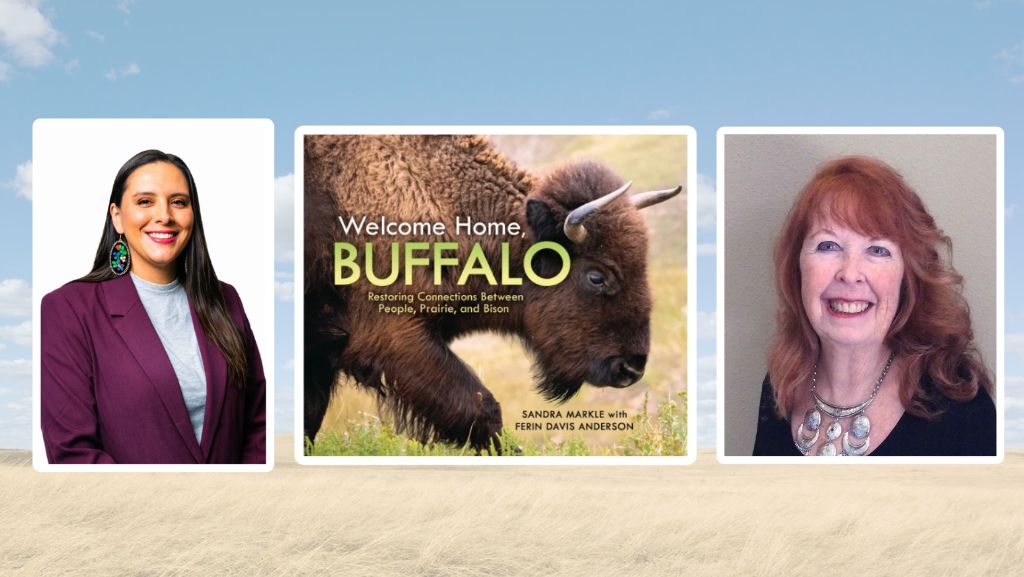
The lives of buffalo, Indigenous people, and the North American prairie have long been intertwined. Welcome Home, Buffalo: Restoring Connections Between People, Prairie, and Bison informs readers about how returning buffalo to their historic ranges benefits Indigenous people as well as the prairies they steward.
Today, we hear from authors Sandra Markle and Ferin Davis Anderson about their inspirations, writing process, and hopes for young readers.

What inspired you to tell this story?
Sandy: I’m always on the hunt for the hunt for events, interviews, and reports that make me wonder, What happened next? or Is there more to that story? Both of those were triggered by my reading an interview with Ervin Carlson, buffalo project manager, Blackfeet Tribe, Browning, Montana. He told me about the buffalo coming to the Chief Mountain area from Elk Island National Park in Canada. He said, “Children need to understand this is not just for the land and the animals. You know this [the buffalo] is a big part of culture that was taken away.” I knew then that I needed to know more about this story—its past, present, and future.
Ferin: As an Indigenous ecologist, I’ve seen how bringing buffalo home restores relationships between the land and people, elders and youth, memory and place. I wanted young readers to feel that reconnection and see themselves as caretakers.
You frame the buffalo, prairie, and Indigenous people as inseparable. Why is this important for young readers?
Ferin: In Anishinaabe teachings we say Indinawemaaganidog “all of my relatives.” That includes plants, animals, water, and people. Seeing buffalo as relatives fosters responsibility and reciprocity, not just curiosity.
A lot of different people shared their personal experiences and insights for this story. Is there one interview that really stands out to you? And something that didn’t make it into the book?
Sandy: There are parts of every interview that are special. I have always loved feeling connected to my ancestors through the passed down family stories. I will never forget both the story Helen Augare, managing director at Blackfeet Community College, Browning, Montana, shared and the heartfelt way she shared it. The buffalo calves being brought from Canada was her great-great grandfather’s story. Another story—one that didn’t make it into the book but was definitely special—was shared with me by Lauren Markewicz, Public Historian with Bison Specialist Group with IUCN. She told me that she was invited to watch Indigenous dancers participating in a ceremony for the buffalo. She said, “That dance they did with the rattles and stuff . . . They did this sparring thing where you try to get your shoulder underneath each other. Male buffalo do that. They wrestle by trying to flip each other over. That’s why they often get horned in the hump. These dancers were from a community that had bison removed from them for like 150 years. Yet their songs and dances preserved an element of buffalo behavior. I think that speaks to a deep connection between humans and buffalo.”
The book includes “Stories with Ferin.” How did those pieces come together?
Sandy: I always want my books to let readers experience being immersed in the story. For all my research and interviews, I couldn’t share living the Indigenous cultural heritage of knowing American bison. Ferin does that for young readers with her personal experiences and historical insights.
Ferin: I wanted readers to know what it was like to be in the prairie, to be around bison, and to not fear fire. These sections invite readers to slow down, feel dew on prairie grasses, listen for grasshopper sparrows, and smell smoke from fire. Sensory memory deepens learning and builds empathy.
What was the most challenging part of bringing this story to life for children?
Sandy: My research for this story was extensive because it is the story of the Indigenous people, the prairie, and the American bison. The challenge was to interview those people who were living this story now—every part of it. Identifying them, contacting them, and talking to them. That took digging, emailing, having the privilege of talking with them, and then winnowing out what was key to this shared story of Indigenous people, the prairie, and the buffalo.

The history you share includes hard truths about boarding schools, land loss, and the Great Slaughter. How did you approach that for young readers?
Ferin: Truth-telling is part of healing. When readers understand why the buffalo disappeared, they can better appreciate what it means to bring them home.
What do you hope readers will learn, or unlearn?
Ferin: I hope that readers learn that fire can be good and can be a life-giving tool and that buffalo do more than just survive, they create habitat and help us learn how to be good to one another.
Praise for Welcome Home, Buffalo
“Markle’s name on a new book is a sure sign of thorough research, quality information to engage young readers, and stories that go beyond simple, historical facts to become deeply relevant to today’s readers.”—Booklist
“Broad, illuminating, and overall upbeat.”—Kirkus Reviews
“Packed with stunning contemporary and historical photographs and maps, and content includes quotes from primary sources. . . . a unique look at buffalo and would be a great addition to middle-grade nonfiction collections, especially those located near sites where buffalo have been reintroduced.”—School Library Journal
Connect with the Authors

Ferin Davis Anderson is an environmental scientist and an enrolled citizen of the Turtle Mountain Band of Chippewa/Ojibwe/Anishinaabe/Mitchifs in North Dakota. She works as the Supervisor of Environmental Sciences for the Shakopee Mdewakanton Sioux Community’s Land and Natural Resources Department where she is responsible for stewarding and restoring natural areas for the SMSC. Ferin weaves traditional knowledge and western science together to make more holistic management decisions, including using fire as an ecological and cultural tool to achieve beneficial and healing outcomes. Witnessing Indigenous people revitalize and reconnect with this practice has been one of the greatest gifts of her career.

Sandra Markle is the author of numerous award-winning books for children. A former elementary science teacher, she is a nationally-known science education consultant. Markle has received many honors for her series Animal Predators, Animal Scavengers, and Animal Prey. Several titles have been named as National Science Teachers Association (NSTA)/Children’s Book Council (CBC) Outstanding Science Trade Books for Students K-12, and Animal Predators was honored as a Top 10 Youth Nonfiction Series by Booklist.
Photo Credit: Skip Jeffery Photography


Comments