Playbook for Justice: An Interview with Author Lesley Younge
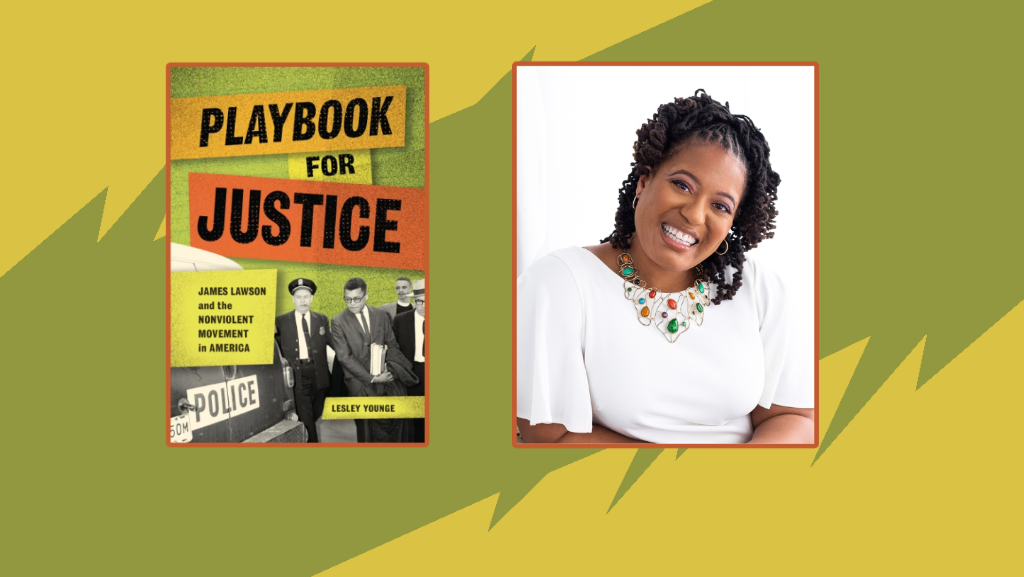
Even as a small child, James Lawson wanted to create a fairer world—a world where people of all backgrounds could live in dignity and peace, as equals. The new young adult nonfiction, Playbook for Justice: James Lawson and the Nonviolent Movement in America, explores how he did just that. Part history of a powerful tool for change, part biography of an impactful activist, and part guide for practicing nonviolence in daily life, this book shows how anyone can train to be a nonviolent athlete.
Today, author Lesley Younge joins us to share her inspiration for the book and what she hopes young activists will take away from James Lawson’s story.

What was your inspiration for the book?
As a sixth-grade teacher, I was delighted to see March: Book One by Congressman John Lewis land on our reading list. I began reviewing it in preparation for our unit and was shocked to see my childhood pastor, Reverend James Lawson Jr., depicted in the graphic novel! He’d been a leader of the nonviolence workshops in Nashville, Tennessee, where John Lewis began his own training. It dawned on me that James Lawson was John Lewis’s teacher. I called my father immediately to ask if he knew of this. “Of course,” he said. “Weren’t you listening to the sermons? He talked about it all the time!” No, I guess I hadn’t been listening.
Later that year I had a chance to meet Congressman Lewis. When I mentioned that James Lawson was my pastor, he responded, “Jim? We would have been lost without Jim. I don’t know what we would have done without him.”
As I began looking for texts to support this angle of personal connection and storytelling in my classroom, I was disappointed to find out there were no books about Reverend Lawson available for young people, though he is mentioned in at least two children’s books about John Lewis. I knew I needed to help tell his story and share his teachings.
What is the most surprising thing you discovered while researching or writing the book?
I gained a deeper appreciation for the level of organization, strategy, and discipline within the US Civil Rights Movement. I knew that activists didn’t just show up for the demonstrations, but I underestimated how much time they spent planning and building their capacity. I also learned how much they sacrificed, especially the young people. They were willing to be jailed and thrown out of college for their beliefs. Some of them were defying the wishes of their families. It helped me understand that to be an agent of social change means taking real risks. There is nothing safe about being a nonviolent activist. It is truly a way of life for courageous people.
What do you hope readers will learn or discover from reading your book?
I was fortunate to have studied directly with Reverend Lawson through his Soulforce workshops at Holman United Methodist Church before his death in 2024. I’ve tried to capture the teachings, historical examples, and deep questions that stuck with me. Lawson’s nonviolence workshops were more than just meetings. They were experiences that changed people’s hearts and built powerful communities. I hope young people read these books and become more skeptical that we have to resort to weapons or be driven by fear. I hope they walk away curious about what a nonviolent life might look like for them. I hope they feel more optimistic about the future and their role in it.

For every page of a finished book there are many pages of research that didn’t make it to print. What is one thing you learned that did not make it but remains essential to this subject?
The structure of the book changed drastically as it developed. It was originally going to be more of an anthology that included writings by other people. For instance, I really appreciated a 1945 essay by George Orwell, the author of Animal Farm and 1984. It’s called “The Sporting Spirit.” In it, he makes a pretty compelling case that the culture around sports leads to violence. By contrast, Reverend Lawson played several sports growing up and was even a coach. He used a lot of sporting analogies and liked to talk about nonviolent activists as “athletes” who trained and prepared for the opportunity to face the real opponent: injustice. I couldn’t print the essay, but I think it represents the opportunity to examine our approach to everything. Sports can be violent or nonviolent, and maybe every aspect of life has that nuance. We always have an opportunity to make these choices.
What is the one complex question you hope readers will keep thinking about after they turn the final page?
The question that drove me to write the book came from a meditation teacher I follow, Jack Kornfield. He asks: “How Can I Be Where the War Stops?” That question has led me to become a consistent meditator, to practice nonviolent parenting, to be a more emotionally attuned teacher, to join community organizations doing work I believe in, and to bring a conflict resolution curriculum to my school. It’s pretty powerful, and every person can have a different path.
Praise for Playbook for Justice
“A biography that brings hope in dystopian times.”—Kirkus Reviews
“Younge’s impassioned tribute to Lawson’s legacy is the perfect way to introduce teen readers to nonviolence and activism at large.”—Booklist
“Whether absorbed in sections or as a whole, readers interested in history or activism will find this work valuable.”—School Library Journal
“Packed with valuable historical information alongside the life story of a courageous historical figure, Playbook for Justice is an essential history book about the power of peaceful protests.”—Foreword Reviews
Free Educator Resource
Download this free teaching guide to jumpstart conversations in the classroom and beyond.
Connect with the Author

Lesley Younge is a middle school educator, poet, and author of several books for young people including Nearer My Freedom, an award-winning verse novel remix of Olaudah Equiano’s autobiography, and A-Train Allen, her first picture book. Originally from Los Angeles California, Lesley attended New York University and Bank Street College of Education, where she discovered a passion for supporting young people’s learning. She lives with her family in Silver Spring, Maryland and has become a big fan of Old Bay.

Comments