When It’s Your Turn for Midnight: An Interview with Author Blessing Musariri
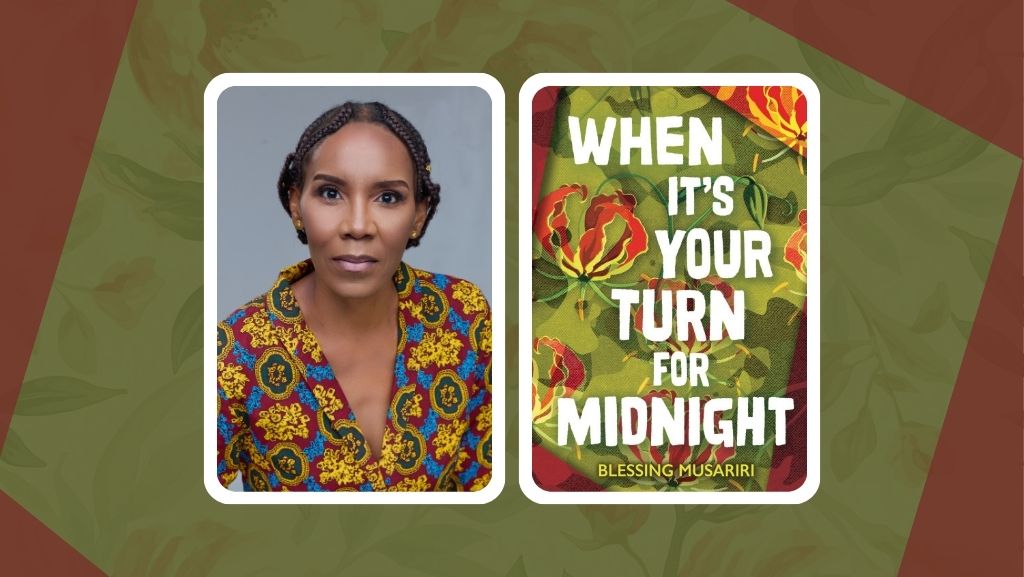
What would you do if everything you believed about your life began to unravel? In When It’s Your Turn for Midnight, author Blessing Musariri explores identity, family secrets, and the quiet strength it takes to face the truth, all set against the rich cultural backdrop of Zimbabwe.
In this interview, Blessing shares the personal and cultural inspirations behind the novel, the emotional journey of her main character, and how themes of community, resilience, and self-discovery shape this powerful story.

How did you decide to become a writer?
I’ve wanted to write since I was in junior [elementary] school. When we did English composition I used to write complex surrealist stories that stumped my teachers. My imagination has always been vivid and active, and I’d been an avid reader all my childhood, so the compulsion to write formed almost on its own. In high school I tried to create a magazine with a friend, then progressed to writing romances—which I never finished. As a young adult, I quit my job and traveled to America, where—after applying for many jobs I didn’t want—it finally came to me one evening, while I was telling my sister a story about one of my friends, that I wanted to write a book. So I came back home to Zimbabwe and began to write.
What gave you the idea to write this novel?
I was inspired by a number of things, including how deeply, in Shona culture, a family can be impacted by issues of bloodline. I wanted to explore how destructive secrets can be. I’d also spent considerable time in my young adulthood assisting people in Zimbabwe with compiling war memoirs because I was interested in the history of the Liberation Struggle. I lived through that time on the periphery of the independence movement, and I had my own memories that I wanted to reconcile with facts.

Chianti has to cope with a lot of change in the story. What gets her through the challenges she faces?
It’s important for Chianti to understand her own identity. A suspicion has always lived deep inside her subconscious that something wasn’t quite right, and this affected her relationships with everyone in her immediate family. Chianti’s feeling that she always had to be good was predicated on an instinctive desire not to rock the boat because there was something dark lurking under the surface of her life. So she was never really peaceful within herself. Understanding her identity helps to ground her and gives her a better sense of security about her life.
Sisterhood and community are also crucial for her. A support system means the difference between simple survival and thriving. It provides upliftment, love, and laughter, without which past traumas would continue to rule over the present.
What were the most enjoyable and most challenging parts of the writing process?
I thoroughly enjoyed the “company” of the gogos and Mr. Kingsley Pfupajena, even though they were fictional characters. I felt a part of the community they’d created, and I loved being able to put their world onto the page. I enjoyed sifting through the challenges and nuances of Chianti’s relationship with her sisters. My biggest challenge was writing the audacious plan of action against the robbers and setting up a scenario that could be plausible while at the same time being completely outrageous.
What do you hope readers from outside Zimbabwe take away from the story?
It’s important for young readers to read stories that are outside of their own experience because it grows their intellect and expands their capacity to be empathetic to others whose lives are different from theirs.
Note: This interview was adapted from a conversation in Good Reading Magazine.
Praise for Whose Tree Is This?
“A sparkling jewel of a story grounded in emotional truths.” — starred, Kirkus Reviews
“A brief, beautiful Zimbabwean novel about war and family . . .” — School Library Journal
“In the end, [Musariri] has taken an age-old narrative—the meaning of family—and given it a wholly fresh, new look.” — Booklist
“Lyrical yet grounded, full of sensory detail while deeply attuned to the emotional terrain of adolescence, giving the narrative both intimacy and weight.” — Horn Book Magazine
Connect with the Author

Blessing Musariri is a Zimbabwean writer who has published short stories, poems, and novels. Her most recent YA novel, All That It Ever Meant (Zephyr/Head of Zeus and Norton, 2022), received starred reviews from Kirkus, Publishers Weekly, and School Library Journal, was a Junior Library Guild selection, and was chosen as an honor book by the Children’s Africana Book Awards. Blessing has worked as a freelance editing and proofreading consultant and as an English teacher.


Comments