The Real Rosalind: An Interview with Authors Debbie Loren Dunn and Janet Fox
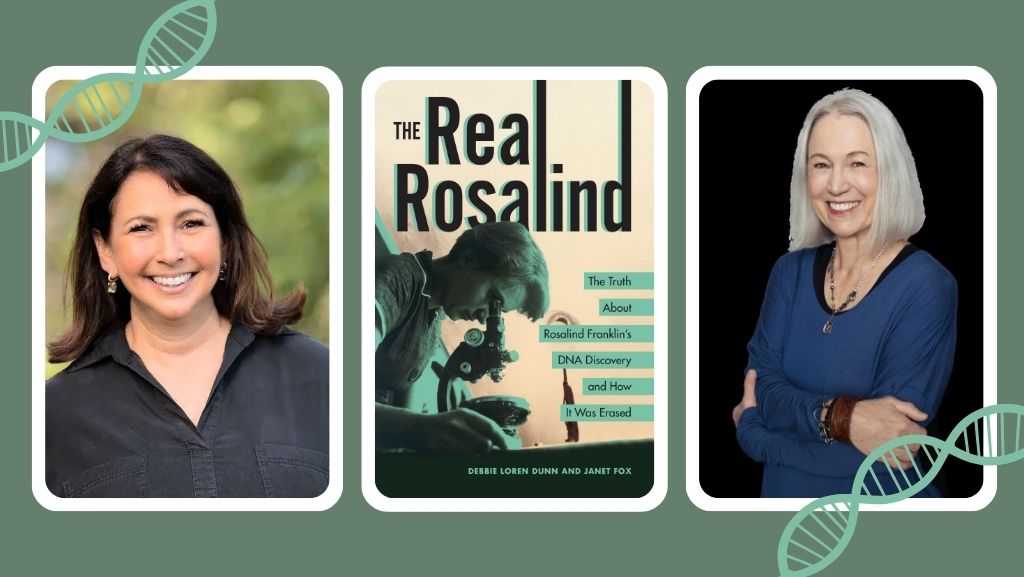
For years, Rosalind Franklin’s name has lingered in the background of one of science’s greatest discoveries, but her full story has remained largely untold. In The Real Rosalind, authors Debbie Loren Dunn and Janet Fox bring her out of the margins and into focus, revealing a scientist whose work, curiosity, and determination extended far beyond DNA.
Today, Debbie and Janet join us to share what surprised them most in their research, how they uncovered Rosalind’s life through rare archival materials, and why they felt compelled to tell the story of a woman whose contributions shaped science in ways many still don’t fully recognize.

Why is the book called The Real Rosalind? Why focus on “Real” specifically?
We had never heard of Rosalind Franklin. Most people haven’t. Many in the scientific community don’t know about her either. The few that do recognize her name might correctly associate her with DNA.
We wanted to tell Rosalind’s whole story. Yes, in the early 1950’s she did use X-ray crystallography to unequivocally prove that the structure of DNA was a double helix, while others modeled or assumed its shape to contain triple or quadruple strands. But the real Rosalind’s work went beyond DNA. She had other groundbreaking discoveries in addition to discovering the structure of DNA; her DNA work was sandwiched between an earlier time-period when she uncovered the structure of coal and a later time-period when she worked through the structure of complex viruses.
What is the most surprising thing you discovered while researching or writing the book?
We were happy to see how well-rounded Rosalind was. The extreme passion and dedication she had with her scientific work was the same with her hobbies: hiking, traveling, dressing chic, and all things French.
How did you research a topic from the 1940s?
There wasn’t an autobiography; Rosalind never stopped long enough to write about herself. So, the research led us to the Rosalind Franklin archives in Baltimore to look at items her friend, Anne Sayre, had saved and the Wellcome Trust archives in London to see the physical items saved from the university labs. It was a blast to put on white gloves and hold Rosalind’s actual notebooks, the letters she wrote, the letters she received, and hear the taped interviews of people she worked closely with.
We also read the autobiographies of three male colleagues she worked with on DNA. It was interesting to see how they all recognized her intellect, but on the flip side her love of debating issues and treating each experiment with extreme diligence scared some. Everyone seems to have been delighted or bothered by her meticulousness in the lab, especially when it came to interpreting her lab results.
Some readers might see a little bit of themselves in Rosalind, but overall, we hope our readers feel her passion and fight.

What do you hope readers will discover in The Real Rosalind?
We hope readers see a young woman who never swayed from her intentions: to both work in science and to work in a professional environment. This was a big ask in the 1940’s and early 1950’s. She battled to stay true to her specific aspirations both within her own family and as well as the scientific community.
Rosalind’s total commitment to science often earned her a reputation for being difficult or stubborn, especially for the time and place. We want readers to feel her passion her fight and the tradeoffs this amazing woman had to balance to achieve her goals.
Praise for Whose Tree Is This?
“A well-researched, candid, and highly recommended biography . . .” — starred, Booklist
“An engaging, quick read about an important and fascinating pioneering scientist and a worthy addition to libraries’ teen collections.” — School Library Journal
“While intermittent sections detailing the scientific subjects addressed are somewhat dense, the information is enlivened by details of Franklin’s sharp, fearless observations of her male peers and their foibles.” — Publishers Weekly
“Illuminates Franklin’s brilliance and the labor and uncertainty of her groundbreaking research. Blunt, accurate, and no-nonsense—just like the subject herself.” — Kirkus Reviews
Connect with the Authors

Debbie Loren Dunn is an author of nonfiction books for children and young adults based in Texas. She graduated with a degree in computer science from the University of Texas at Austin and worked in the computer industry for twenty years specializing in databases and data mining. She holds an MFA from Vermont College of Fine Arts and loves true stories about people doing amazing things—especially when others have told them they can’t, or they shouldn’t. Debbie’s volunteer work includes having served as a Board Trustee of VCFA, a Board member of The Writer’s League of Texas, and Regional Advisor for SCBWI Austin Chapter. She also served on the Board of the ARC—Texas Disability Services and on the Board for the Central Texas Crohn’s and Colitis Foundation.

Janet Fox is the author of fiction and nonfiction books for young readers. Her work has received numerous awards and accolades including a SCBWI Golden Kite Award, a Bank Street Best Books Award, and the Florida Sunshine State Young Readers Award Master List. Janet received a Master of Science degree from the University of New York, Albany, in marine geology and authored/coauthored a number of respected scientific research papers. She is a former middle school/high school teacher and has an MFA in from Vermont College of Fine Arts. She lives in Bozeman, Montana.

Comments