The Ocean’s Heart: An Interview with Author Jilanne Hoffman
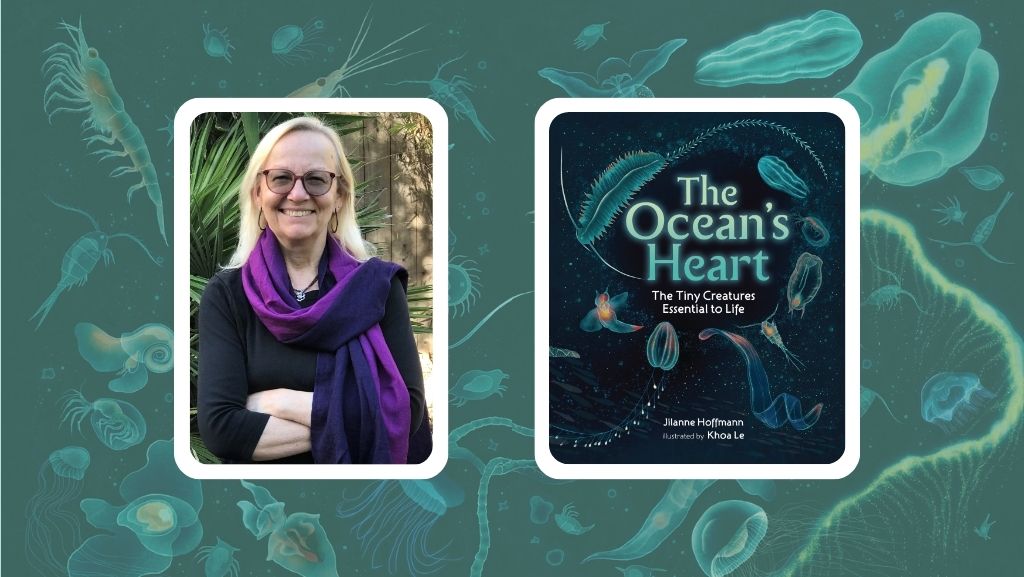
Every night zooplankton race to the ocean’s surface to feed on tiny plants called phytoplankton, creating the largest migration of animals on Earth. The Ocean’s Heart: The Tiny Creatures Essential to Life by Jilanne Hoffmann and illustrated by Khoa Le takes readers on an unforgettable journey as these zooplankton bring nutrients from the surface down into the depths, helping to nourish the many larger animals that prey on them.
Today Jilanne Hoffmann joins us to share why she writes science books for children, how she discovered the zooplankton’s migration, and why the zooplankton are so important.

What is your connection to the ocean?
I grew up on a farm in the landlocked Midwest, so my early experience with the ocean came from watching The Undersea World of Jacques Cousteau. I loved that show! They focused on the large sea creatures that made for exciting TV. Fast forward a few decades, and I had snorkeled at the Great Barrier Reef (giant clams, clownfish, sharks!) and around the reefs in Tahiti (angel fish, puffers, more sharks!) and the Caribbean (parrot fish, damselfish, dolphin, and barracuda!). I loved being immersed in this glorious liquid world! And while I knew there were all kinds of tiny plants and animals in the water, my focus was—like Cousteau’s—on the large, colorful sea life swimming around me. I was smitten.
How did you find out that zooplankton migrate?
By accident! I was researching the dust that flies from North Africa to the Amazon for my first picture book, A RIVER Of DUST, when I discovered zooplankton’s secret. A NASA satellite named CALIPSO not only recorded the movement of dust through the atmosphere but also the movement of zooplankton far below the ocean’s surface. The satellite tracked their journey—cued by the setting sun—from the Twilight Zone and back each night in one continuous wave around the planet. Zooplankton use the darkness to hide from predators at the surface while they gorge themselves on phytoplankton, the food they need for their survival. Smart thinking if you’re small and trying to survive.

Why should anyone care about such tiny, unimportant plants and animals?
Without them, we’d all be toast. Seriously. Trillions of phytoplankton float in the ocean’s surface waters, taking in carbon dioxide (a greenhouse gas) and producing oxygen in an amount equal to that produced by all other plants on Earth, including trees! Then billions of zooplankton do us a huge favor by eating phytoplankton. Individuals can eat up to 400,000 tiny plants a night! Then they take their bellies bulging with phytoplankton carbon back into the deep ocean when the sun rises, helping to slow climate change.
But we should also care because every sea creature deserves our attention and respect, no matter how small. These tiny living things have beautiful structures and abilities. From the crystal palaces of diatoms (phytoplankton) to the tricky prey-luring luminescence of siphonophores (some of the world’s longest animals) to the pulsating ballet of jellyfish and sea angels, you can’t help but love zooplankton once you see them in action.
Why do you write science and environment-related books?
In the way that Jacques Cousteau’s television show inspired me, I hope my books will inspire kids to explore and discover the wonders of Planet Earth. And maybe some will decide to become the scientists and environmentalists we need now more than ever. Or maybe they’ll want to become science teachers or authors who share their love of science.
What do you hope readers will take away from The Ocean’s Heart?
I hope readers will be awed by this nightly migration, the pulse of the planet. I hope they’ll love the exquisite beauty of these tiny creatures that some call “kinetic glass.” And, in turn, they will want to protect and learn more about the ocean, one of the most mysterious and fascinating places on Earth.

Praise for The Ocean’s Heart
★ “Le’s swarms of translucent, detailed sea life offer a series of ghostly spectacles that go wonderfully well with the oratorical narrative to make a big splash with young readers.”—starred, Booklist
★ “This shimmering tale of interdependence and survival is STEM storytelling at its best.”—starred, Kirkus Reviews
“An interesting, dynamic resource that makes complex environmental science accessible.” —School Library Journal
“Utilizing brief, poetic language, the narrative invites readers on a journey through the ocean, from the depths of the twilight zone to the surface, on a path that zooplankton travel every day. Thoughtfully designed illustrations present a wide variety of zooplankton in a setting that is accessible for young readers, occasionally modifying the traditional display of a picture book to offer a more resonant representation of the depths to which these creatures descend. Reviewer Rating: 5″—Children’s Literature
Connect with the Author

Jilanne Hoffmann has been a zoo train engineer, a waitress, a “real” engineer, a fitness trainer, a tai chi instructor, a freelance writer for nonprofit organizations, and now enjoys writing stories for kids and adults. She has a BS in Engineering and an MFA in creative writing. Her picture book, A River of Dust, was an ALA Notable Children’s Book, a Bank Street College Best Children’s Book, a Junior Library Guild Gold Selection, and an SCBWI Crystal Kite Winner. She lives in San Francisco with her husband, son, and rescue dog named Wrigley.

Comments