Choir Grrrl: An Interview with Author Ashley Granillo
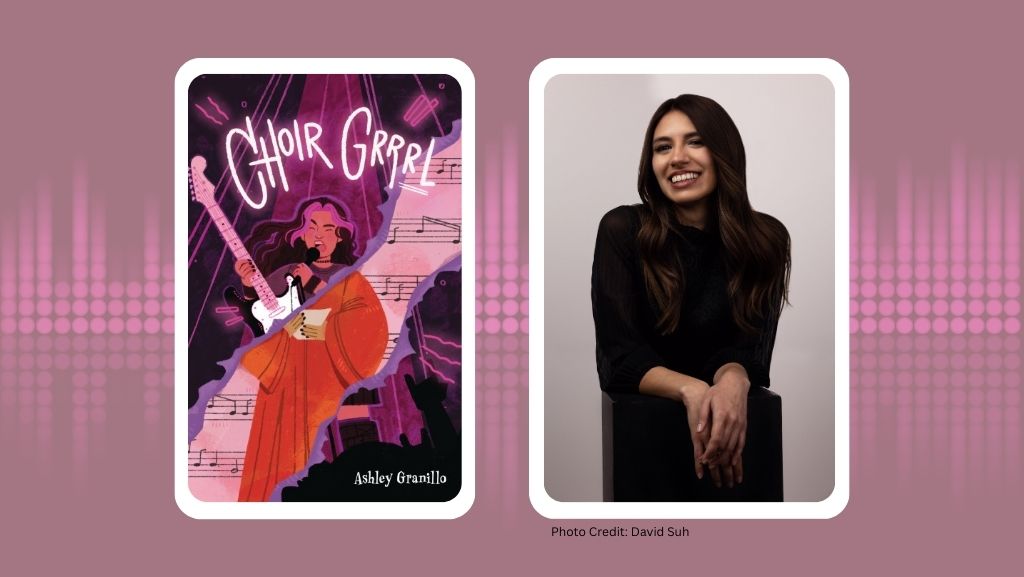
Sing it loud, sing it proud! In Choir Grrrl, thirteen-year-old Alondra was born into a musical family; her dad, former frontman of an alt-rock band, has taught her and her sisters to follow in his footsteps. Despite secretly liking quieter music, Alondra is committed to the band she and her sisters have formed. But when a classmate recruits her for a choir group, Alondra rediscovers her love of singing and making music. Afraid to upset the delicate balance in her family, she covertly practices with the choir between shows with the band—until her secrets are exposed. Can she bring the different parts of her life into harmony?
Musician and author Ashley Granillo joins us today to share her inspiration behind Alondra’s struggles, her favorite bands, and more. And if you’re looking for an encore, keep reading to download the free discussion guide!

How did you come up with the concept of an emo girl wanting to become a choir girl?
I was in a ton of choirs from fourth grade through my senior year of high school. My parents couldn’t afford to enroll me in music classes, but choirs were typically a free resource! Around tenth grade, I also started getting into emo music. My favorite boyband, *NSYNC, had gone (pun intended) on hiatus and I needed a new sound for my angst. So I sort of merged my two passions: singing with people and singing really sad songs. On many school nights, if I wasn’t practicing choreography for show choir, I had my dad or my cousins drive me to Hollywood to watch my favorite bands perform.
As an adult, I realized that many members of bands I love now have kids. What might they think of their parents’ chosen genre? It seems like a common progression for kids to shy away from classical music toward something sonically edgier. But what might rebellion look like for someone born into the emo scene, raised on angst as a default? I decided to explore that with Alondra.
Alondra has trouble with her voice “fitting in.” Why were you interested in exploring girls’ and women’s voices?
Ever since I was young, people have been telling me what my voice sounds like to them, how they think it should be categorized. As a teenager I wanted to scream. My voice, however, was deemed “too cute” and “too sweet” to be part of the rock genre. Those frustrating comments often came from boys who didn’t want me to be in their bands—or in any band. Yet women also made assumptions about what my voice could be. A vocal coach once had me make a list of singers who inspired me. When I showed her my list of women in rock (indie, emo, etc.), she made a face and said, “You don’t want to sound like that. You could be so much more.” For her, “more” meant being a pop diva, focusing on pure sounds and big belts.
For a long time, I was in vocal limbo, trying to figure out whether to appease an audience or do what feels right in my body. I’ve decided to sing in ways that feel authentic to me, and I want everyone to have that freedom. Alondra should be able to have this pure beautiful voice against crunchy guitars. Why not?
Who were some of your favorite bands growing up? Did any of them inspire you when you were writing Choir Grrrl?
I definitely “walked down memory lane,” as the saying goes in a Fall Out Boy song, as I wrote this novel. As a young teen, I was into Waking Ashland, the Ataris, Evanescence, Fall Out Boy, and My Chemical Romance. Each of these bands gets a shoutout in the book. Hayley Williams from Paramore, my biggest vocal icon, is referenced too. I also wanted to recognize new bands—the queer, BIPOC young people who are reenvisioning the rock scene—like Meet Me at the Altar, She/Her/Hers, and the Linda Lindas. I wish I could’ve heard bands like them growing up.
The novel features three very different sisters as part of the fictional band Beyond the Valley. What is your relationship like with your own siblings?
My younger sister is a Gemini. I joke that, as her astrological sign suggests, she can be two different people depending on the situation. I used those different aspects of her personality to create Alondra’s younger siblings, Elisa and Gloria. But of course, Alondra loves her sisters equally, and I love all sides of my sister. She’s my very best friend in the whole world—even when she makes fun of me or tries to get on my nerves. That’s what sisters do, even at our old age, I guess.
I heard you also wrote music for the novel. Did the music or the story come first?
Yeah! Writing this book allowed me to combine two major facets of my life. The story idea came first, but I’ve released two albums, so I thought it would be a good exercise to write a song for my book in the style of the band and the character.
Initially, I only had a song title “Smog on the Horizon” (actually the version is much longer in the book in true emo fashion). During a songwriting workshop with Greta Morgan, I used some of her writing prompts to start drafting lyrics. The melody emerged soon after. With help from my producer and cowriter, Matt Marquez, the music was born. It’s been so fun to tap into a character, especially a character I invented, and sing the way I imagine she would.
Now, everyone can listen to “Smog…” and get a sense of Beyond the Valley’s sound.
What made you decide to incorporate Alondra’s experiences with dyslexia into the story?
I share her experience, although unlike Alondra I was never properly diagnosed as a child. Around third grade, I started having issues with spelling. My brain naturally mixed up letters, putting them in the wrong places. Because I was a strong reader, my teachers figured I was just lazy when it came to writing. The character of Mrs. Sharp is, unfortunately, based on some of these teachers who thought by punishing me, they were helping me improve.
Well into adulthood, I continued to have spelling issues. In college, my professors sometimes asked if I was intentionally putting words out of order for poetic purposes, or making spelling mistakes as part of the artistic form!
Through Alondra, I wanted to show how a learning disability can impact the ways someone processes their thoughts and writes them on the page.
Why is poetry such a focal point of the story?
I might be one of the few English majors who never liked studying Shakespeare. But poetry, as a genre, was my entrance into songwriting. I was the kind of kid who checked out random poetry books from the dusty, forgotten side of the library. I’d then turn the verses into songs with my own melodies on my Casio keyboard.
In turn, music helped me spell and understand language. It became a natural part of how I conceptualize stories. Knowing that Alondra shared my struggles, and knowing her strengths as a songwriter, gave me an opportunity to show the multitude of ways students can process language. Emotional writing doesn’t always follow stringent rules.
What advice would you give to kids (or anyone!) who struggle to find their voice on the page or elsewhere?
Let yourself fail—by which I mean, don’t let the idea of perfectionism hold you back. Let your singing be pure or raspy. Let your grammar be imperfect and your spelling reckless. By failing, you’ll understand how you’d like to improve. And remember, those mistakes aren’t a reflection of the authentic you. Focus on the heart of the story, which is where yours resides, and it will guide you forward.
Free Educator Resources
Encourage readers to use their voice during discussions with these insightful questions.
Praise for Choir Grrrl
“Granillo’s lyrical text demonstrates the creative power of music to express new ideas, make meaningful connections, and heal damaged hearts. . . .Choir and band nerds will love this story featuring found families and musical joy.”—Booklist
“Warm and funny with strong, realistic characters, Granillo’s sophomore novel explores issues including parental conflict and the representation of girls, women, and Latine people in rock. . . An emotional, well-realized story about finding your voice.”—Kirkus Reviews
“Tackling tough topics like identity, divorce, family conflict, and learning disabilities, this novel is unafraid to confront big issues facing young readers today. For older middle grade readers, this coming-of-age, feminist story will inspire readers to find their own paths.”—School Library Journal
Connect with the Author

Ashley Jean Granillo is a Mexican American writer and educator hailing from the San Fernando Valley. She has her BA and MA in creative writing from California State University Northridge and holds her MFA in fiction from the University of California Riverside, Palm Desert. She is also a member of Las Musas, a collective of Latinx authors whose gender identity aligns with femininity. Her short story “Besitos” was featured in Where Monsters Lurk & Magic Hides, a Latine/x short story genre anthology. Her debut middle grade novel, Cruzita and the Mariacheros, was a 2025 Pura Belpré Children’s Author Honor Book.
Photo Credit: David Suh

Comments