Beyond Seven Forests: An Interview with Author Amanda McCrina
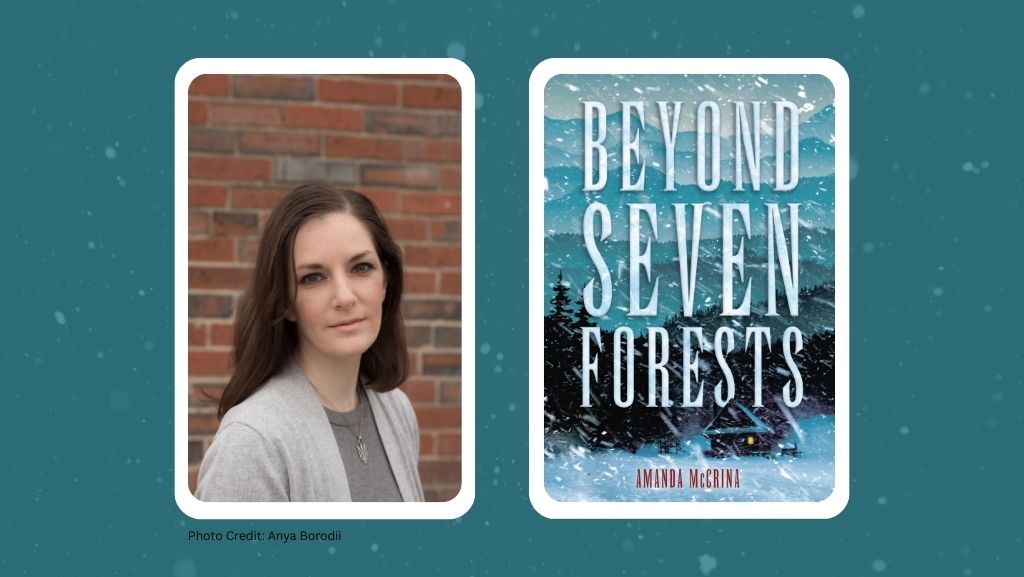
Beyond Seven Forests is a survival story in more than one sense. In the winter of 1916 a blizzard traps eighteen-year-old Polish countess Renata in her home with two Polish deserters from the Russian army. Together they must not only survive but grapple with wartime scars. This young adult historical novel is both a page-turning tale of peril and a hopeful exploration of human connection and resilience in the face of hardship.
Author Amanda McCrina joins us today to share how she developed Renata’s story, how Polish folklore plays a part in the narrative, and more. Read on to find a free discussion guide!

What was your inspiration for the book?
The seed for this story was a single photograph. A few years ago, historian Nicolai Eberholst, who runs a popular social media account focusing on the often-overlooked Eastern Front of World War I, posted a photo of a Ukrainian boy, probably in his early teens, about to be executed by the Austro-Hungarian authorities on a charge of spying for the Russians. That photo stuck with me. It was shocking, disturbing—and completely mundane for that place and time. There would’ve been nothing unusual about it to anyone involved. Violence against civilians was sadly commonplace on the Eastern Front, perpetrated by both sides, and children weren’t spared. But I found myself wondering about that boy’s story and about the stories of the people around him—whether anyone would’ve tried to defend him. The plot of Beyond Seven Forests unfolded from there.
Can you tell us a little about the setting?
Among other things, Beyond Seven Forests is a story about the end of empire. Readers might know that the Russian Revolution happened at the end of World War I. But empires broke apart all across Central and Eastern Europe because of the war. In fact, some historians have suggested that the twentieth century really started with World War I, because the war was what upset the old imperial order of previous centuries.
Beyond Seven Forests is set in a place where three different empires all met—a region called Galicia, and specifically the city of Lemberg (present-day L’viv, Ukraine). I chose it as the setting because it represents in a microcosm the ethnic and political complexities of the entire Eastern Front. Part of the Austro-Hungarian Empire before the war, it was occupied by Russian forces, then was “liberated” by joint Austro-Hungarian and German forces, eventually became part of postwar Poland, and is now part of Ukraine.
What did you find most challenging about writing Beyond Seven Forests?
I’ve written historical fiction before—in fact, I’ve written other books set in Galicia and L’viv before. But Beyond Seven Forests is the first book I’ve written in which real historical figures play important roles. I’ve always found it too daunting to write real people as characters in a fictional story and to put my own invented dialogue in their mouths. But it was impossible to tell the story I wanted to tell without including some of the real people who made this history happen. One of those is Jozef Piłsudski, who later became the leader of independent Poland. Another is his second-in-command, Kazimierz Sosnkowski, who’s got an especially important role in the story.
What role does Polish folklore play in the story?
My main character, Polish countess-turned-medical student Renata Zamoyska, uses old Polish legends and folk tales to frame her own story. These would’ve been the stories she grew up with, so they would’ve been a source of comfort and normalcy to her, and maybe a way to make sense of her own life during wartime. They’re also a quietly defiant way to express her Polish identity in an imperial context. Many Central and Eastern European folk tales are shared from country to country and culture to culture, rooted in the same original sources, but I wanted to be sure that most of the stories Renata references, like the Wawel Dragon, are distinctly Polish.
Why does this history matter today?
The imperial history of this part of the world still has enormous implications. Russia’s present-day war on Ukraine is rooted in old imperial ambition. I’d go so far as to say it’s impossible to understand this war unless you understand the history of Russian imperialism. That’s one reason. Another is that when I started really taking interest in my own Polish heritage in high school, I quickly came to realize that there just wasn’t a lot of literature about Poland for American audiences—especially not in the YA space. So I decided to write some. It became personally important to me to help make sure this lesser-known history isn’t forgotten. I still remember something a former history professor of mine once said: We don’t study history just to avoid repeating the mistakes of the past; we study history to know who we are.
Free Educator Resources
There’s a lot to unpack in this intense historical fiction. Give young adult readers some conversation starters with this free discussion guide!
Praise for Beyond Seven Forests
“Impressively, McCrina has created characters with depth and complicated backstories as well as vividly describing the difficulties of life in an occupied country, a topic rarely explored in teen historical fiction.”—Booklist
“A thoughtful examination of boundaries between right and wrong, carried by the moral tension and strength of the characters, this novel challenges readers to question ethical certainties. Sharp, compelling, and thoughtful.”—Kirkus Reviews
“It’s a complex narrative rendered in the protagonist’s measured voice and filled with references to Polish class distinctions and history.”—Publishers Weekly
“For fans of Libba Bray and Ruta Sepetys, this is a well-written, suspenseful story, which would be a great addition to YA sections.”—School Library Journal
“Readers will quickly sympathize with the intrepid Renia and hope her remarkable story will lead these officers to mercy rather than a harsh retribution.”—Historical Novel Society
Connect with the Author

Amanda McCrina is the author of the YA historical novels Traitor, I’ll Tell You No Lies, Beyond Seven Forests, and The Silent Unseen which was selected as a Bank Street College of Education’s Best Children’s Book of the Year. Born and raised in Atlanta, Georgia, she holds a BA in history and political science from the University of West Georgia. After three years of teaching English, history, and government at an international school outside Madrid, Spain, she now lives outside Nashville, Tennessee, where she works as a bookseller.
Photo Credit: Anya Borodii
Comments