The Writing Room: An Interview with Author Marcia Argueta Mickelson
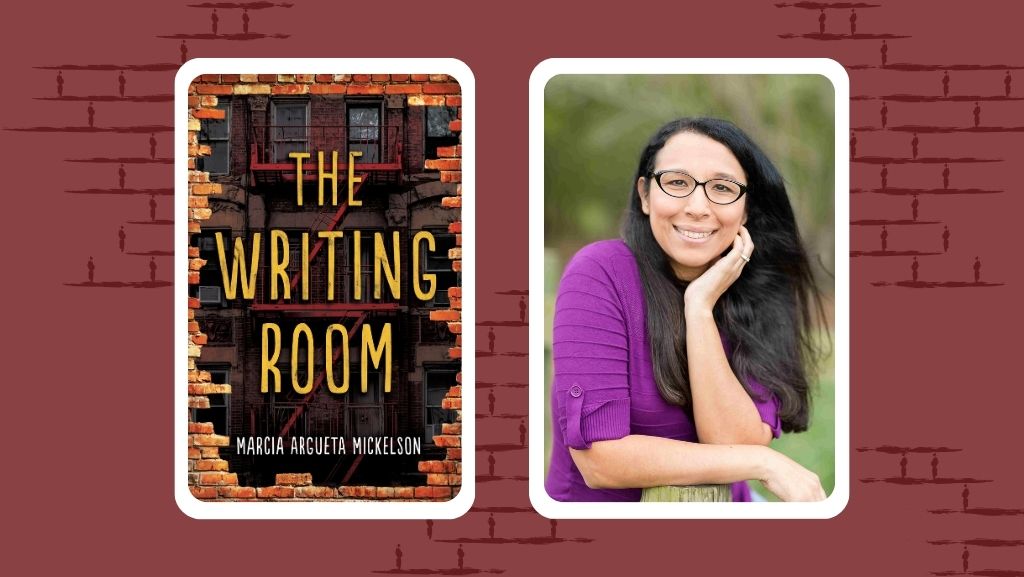
The Writing Room is a slice-of-life coming-of-age story that gracefully addresses larger themes of immigration, economic disparity, and familial struggles. Immediately after high school graduation, eighteen-year-old Maya is kicked out of her wealthy dad’s NYC home.
She struggles to find her footing until she gets access to a “writing room,” a shared workspace where she can focus—and get to know the intriguing neighbor, Jake, who’s often there. When she discovers her dad is bankrolling a virulently anti-immigrant candidate for governor, Maya―the daughter of an immigrant―realizes she can’t continue quietly accepting his choices. She’ll have to take a stand, using the voice she’s found in the writing room.
Award-winning author Marcia Argueta Mickelson joins us today to share why she loves writing stories, how real life inspires her work, and more. Read on to download a free discussion guide to spark conversation after reading.

How did you become interested in writing?
I’ve always loved books and stories. When I was thirteen, I started making up stories in my head. Every night, I would go to sleep with a story in my head. There were times when I couldn’t wait to go to bed so I could continue imagining the next part of the story. In high school, I started writing my first book. It was handwritten on looseleaf notebook paper. Then I bought a computer and started writing the next book. Ten years later, I finished it. It wasn’t very good, but finishing it made me want to write another one and then another one. My third book is the first one that got published and started this amazing journey for me.
How does your own life experience influence what and how you write?
I often put bits and pieces of my own life experiences into my book. My life isn’t interesting enough to write a whole book about, so I have to invent and embellish a lot. Many of my characters are Guatemalan, and I was born in Guatemala. My experience as an immigrant to the United States shapes what I write. Sometimes I add in a few little details about my personal life. For example, in The Writing Room, Maya’s grandmother’s name is Mama Juana, and that was what we called my grandmother.
What comes first for you—the plot or the characters—and why?
I always think of the characters first. I don’t always think of their names right away. In fact, I’ve changed the main character’s name in some books as I write and revise. I often think of the main character and a love interest at the same time. The plot comes later as I figure out how they’ll get together and what they’ll have to go through to get there.
What is a significant way your book has changed since the first draft?
When I first wrote The Writing Room, it was not a YA story. The characters were in their late twenties. It was written in third person and in the past tense. After I started writing the book, I put it aside for several years. I started reading a lot of young adult novels and wrote three of my own. Then I knew I wanted to rewrite the book as a YA novel. The plot changed a lot. I took out some characters and introduced others. I also changed the point of view and the tense. I find that first-person present tense gives the reader more insight into how the character feels and gives the narrative a sense of immediacy.
What advice would you give an aspiring author?
Read a lot in the genre you’re writing, so that you become familiar with the genre and the structure and important points you’ll want to hit in your stories. I also advise that you not get too attached to your first book. Often, the first book is part of the learning process where you’re experimenting, practicing your craft. Soon after I wrote my first book, I knew I had to abandon it, but I didn’t think of my time writing it as wasted. It was all part of the process of becoming a better writer. I also think it’s important to set a book aside sometimes. If something’s not working, take a break from it and work on something new. In time, you can pull it back out and maybe figure out what wasn’t working or what else it needed. I’ve done this with two books, setting them aside for years and then pulling them back out when I was ready to finish them and make them better.
Free Educator Resources
There’s much to talk about in Maya’s story. At every turn she faces challenges in both family, career, and her own self-discovery. Take an extra step with young adult readers and use this discussion guide to explore their thoughts. This free resource is also available on the Lerner website.
Praise for The Writing Room
“With a unique take on the current political climate, this novel explores finding one’s footing in the adult world and standing behind one’s beliefs.”—Booklist
“Over the course of the smoothly wrought narrative, Maya encounters immigration issues challenging individuals in her new neighborhood, expands her literary leanings beyond her beloved classics, and pursues a relationship with Jake.”—Publishers Weekly
“Atmospheric and relevant.”—School Library Journal
Connect with the Author

Marcia Argueta Mickelson was born in Guatemala and immigrated to the United States as an infant. She attended high school in New Jersey and then graduated from Brigham Young University with a BA in American Studies. She is the author of six novels including Star Shining Brightly, The Huaca, and Where I Belong, and she is a winner of the Pura Belpré Young Adult Author Honor. She lives in Texas with her husband and three sons.
Comments