Watch Them Grow: An Interview with Author Carrie A. Pearson
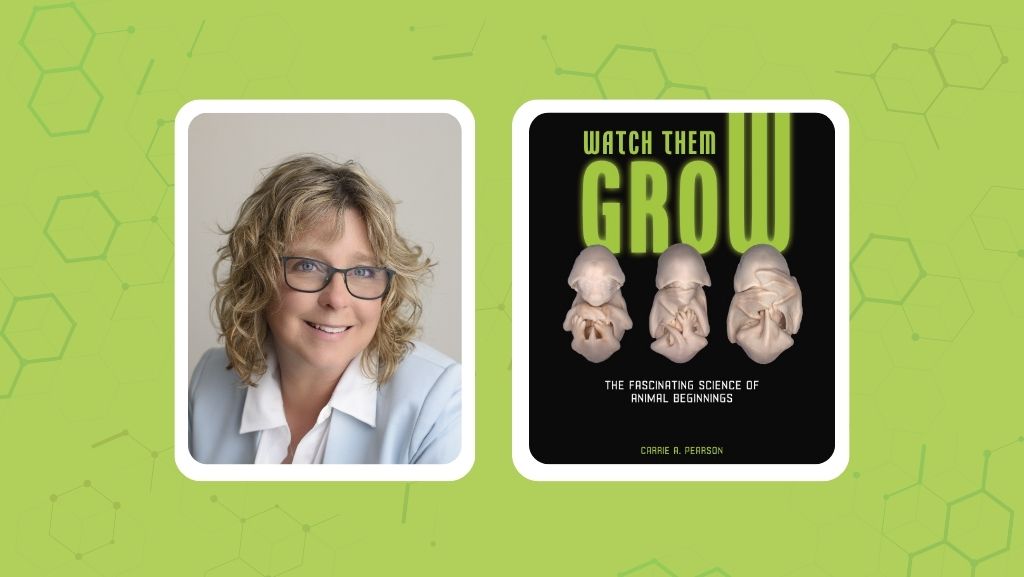
Sure, baby animals are cute. But have you ever seen what they look like before they’re born? Watch Them Grow: The Fascinating Science of Animal Beginnings introduces readers to a variety of animals and shows how they develop some of their defining features.
Today author Carrie A. Pearson joins us to share why she writes nonfiction, how she decided to write about genetics, gestation, and development, and much more! Read on to download the free teaching guide.

Your new book is about baby animals, primarily before birth. Why did you want to explore that?
We see many books about animals after birth, but I wanted to shine a light on the remarkable growth and change that happens before we meet them. A whole world of development occurs inside eggs, wombs, and pouches, and it’s truly awe-inspiring. I also wanted to put the baby-makers on stage and, in my own way, thank them for bringing life into the world.
You’ve said that you write books that answer big questions. What big question were you trying to answer with this one?
This book concept started with: How do animals grow before they’re born or hatched? But it quickly became bigger: How do animals develop what they need to survive? What clues do their beginnings give us about evolution, adaptation, and survival? These are huge questions—and we’re still uncovering the answers.
The book covers sharks, snakes, mice, bats, and more. How did you decide which animals to include?
It was hard to narrow down! I chose twelve animals that represent a wide variety of gestational strategies, such as laying hard-shelled eggs, giving live birth, developing in a pouch, and even hatching from eggs inside the mother. I wanted readers to see both the incredible diversity of the animal kingdom and the fascinating similarities in how animals begin life. It became a puzzle because we wanted to organize the animals into four categories: how they move, sense, ingest, and outliers. Also, primary research guided some of my choices. When I found a research study about an animal’s gestational development, I considered whether that animal would be a possible subject and went from there.

This is a complex nonfiction topic, but you make science accessible in this book. How do you approach writing about genetics and cellular development for young readers?
As a former educator, I know it is crucial to break down big ideas—like DNA and gene expression—into bite-sized, visual, and relatable concepts. Children are naturally curious and capable; they just need information that bridges what they already know with new insights. Additional material builds upon this foundation. For instance, I describe a human karyotype as the “OG selfie.” Most middle-graders are quite familiar with selfies, so this analogy resonates. Additionally, the visuals have been thoughtfully designed to support and enhance learning. For example, the team obtained permissions for photographs from studies I found on the gestational development of specific animal features, such as dolphin flukes. The photo in this section illustrates fluke development from a tubular shape to a flattened triangle at birth. This shape displaces water and enables a newborn dolphin to keep pace with the pod. In one photograph, we can visualize significant concepts of adaptation, gene expression, and prenatal development. Plus, a science educator reviewed the content to be sure it aligned with educational milestones.
What are some surprising things you learned while researching this book?
I was fascinated by how early certain features develop and why. Elephant trunks can be seen about 10 weeks into a 104-week gestation because the trunk is an integral part of an elephant’s survival and needs that time to develop its superpowers. I also loved learning that a tammar wallaby baby is the size of a jellybean at birth, but because it practices climbing in utero, it already has forelimbs strong enough to climb up Mom’s long belly and into her pouch. That blew my mind!

You’ve written several nonfiction books now. What draws you to this genre?
Real life is full of wonder, mystery, and discovery. Writing nonfiction allows me to explore these aspects and share them with readers. I love hearing readers say, “I didn’t know that!” and then, “I want to know more.” I also enjoy providing opportunities to build empathy through knowledge. In this book, we learn that on a developmental level, we are more alike than we are different from our animal friends. That connection strengthens our bonds and makes us want to look out for them.
What do you hope readers take away from Watch Them Grow?
I hope they walk away with a deeper respect for how all living things begin. I also hope it sparks curiosity. If a book can inspire children to ask questions and look more closely at other-than-human beings, I consider that a success.
Free Educator Resource
There’s so much to explore at the beginning of life! Read this fascinating nonfiction and then take a deep dive with this free teaching guide. Download here or from the Lerner website.
Praise for Watch Them Grow
“A great introduction to the science of reproduction in a way that makes animal babies the star of the show.”—School Library Journal
Connect with the Author

Carrie A. Pearson is an author and speaker from Marquette, Michigan. She lives with her husband on the sandy shore of Lake Superior and blows daily kisses to her three daughters, who live on their own now. As a child, Carrie read voraciously. As an early childhood educator, Carrie experienced how books delighted, healed, and enlightened young people. As a mother, she used story to strengthen family bonds. Today, Carrie writes books that expand our world and bring us closer to it.
Comments
We all benefit when Carrie Pearson pens a new book. I learned so much in this interview alone! I’m looking forward to reading this book. Thank you for sharing this insightful interview.
Thank you, Isabel. Coming from you, that means a lot.