Watching and Waiting: An Interview with Author Sara Levine
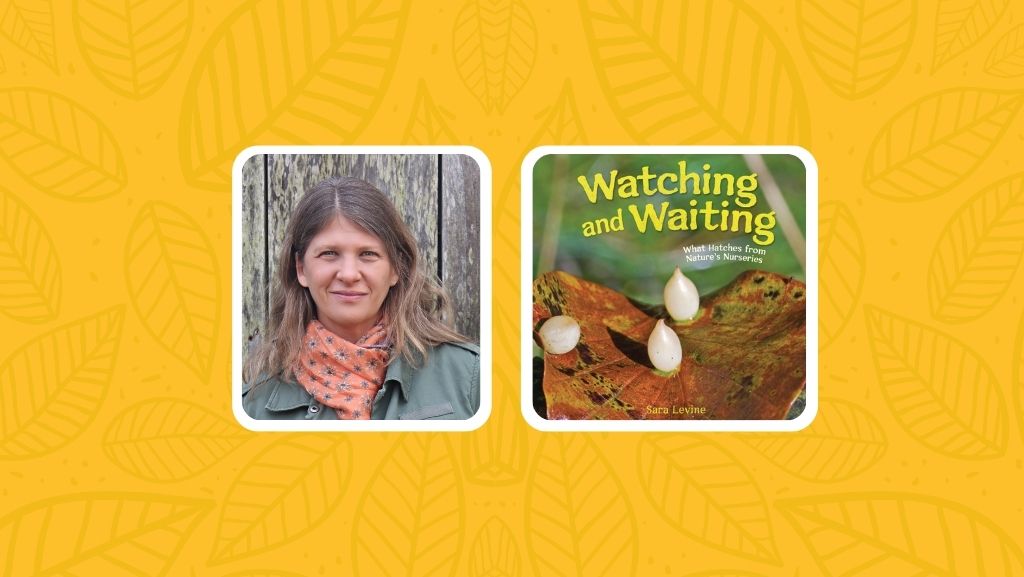
Sometimes the most amazing experiences are born from patience. In the new nonfiction book Watching and Waiting: What Hatches from Nature’s Nurseries, author Sara Levine shares what young readers should do if they find eggs, egg cases, or galls when exploring the outdoors. Simple, lyrical text encourages readers to take time to practice observational science and to respect the creatures they study.
Today Sara Levine joins us to share her inspiration for the book, her journey in observational science, and more!

What was your inspiration for writing this book?
The spark for this book came from the experience of waiting for a relationship I’d hope would happen, knowing the other person wasn’t quite ready. I’ve found that often it’s best to be attentive, observant, and patient and let beautiful things unfold in their own time. This book was born out of this sentiment and my desire to write a lyrical book for children that embraces this observational approach to learning about animals.
What made you interested in writing a book about observational science for children?
When I was a child, I had a deep interest in animals and plants, and also deep empathy for everything alive. These two parts of myself were in harmony and were fostered by my parents and teachers until middle school, where I came to understand that to be “good at science” meant hurting the very things that I wanted to understand. A key moment for me was in seventh grade when we were doing an experiment on planaria. A planarian, for those unfamiliar, is a flatworm with an arrowhead-shaped head sporting two appealing, round eye spots. Our teacher explained that these worms were capable of regeneration; if we cut them in half, the tail end would grow a new head, and the head, a new tail. This idea was fascinating to me. (Were the resulting worms twins? The same individual thinking in two different locations?) Furthermore, if we carefully made an incision in between the two eye spots, the two sides would heal by forming two heads, resulting in a double-headed worm, like something out of Greek mythology.
But, would it cause the worm pain? I asked the teacher. She said, no. That evening I excitedly reported all of this to my father, a scientist and physician. She lied to you, he said. Planaria have two lateral nerves down the sides of their body. I’ll spare you details of my brave (and heartbreaking for all) confrontation with the teacher the next day. That was the first time I realized that I was not cut out to be a scientist. I later confirmed this in college, reading through course descriptions for biology courses. I majored in English and dropped my biology plan. I came back to science circuitously, eventually attending veterinary school, but opting out of some labs, like lethal experiments on live dogs, or dissection of a young greyhound “euthanized” for that reason. Instead, I was able to learn anatomy in a special dissection group with other students who chose to work with the body of an old dog who had lived a natural life before being donated by an owner. Veterinary training was a minefield of difficult decisions, and I did not get through it unscathed. But I suppose no sensitive child does.
As an adult, I discovered scientifically accepted and non-harmful ways to do science. I learned by reading the work of Jane Goodall and others who followed in her path, and by teaching biology to undergraduate students. We can understand much by watching and observing, without killing or hurting. This book is my attempt to emphasize this idea to children and those who educate them about animal behavior and science.

Most egg books for kids focus on animals such as chickens, frogs, and turtles. How did you get the idea to include galls in Watching and Waiting?
I first learned about galls when working as an environmental educator for Massachusetts Audubon when I was in my 20s. They had an excellent handout on this topic that I used to educate myself and the children I worked with. How cool that a plant makes a home for an insect in response to chemicals made by the insect! Galls are such interesting shapes and colors, and they can often be used to identify trees. I loved finding the “witch hat” shaped galls on witch hazel trees while leading walks at the wildlife sanctuary where I taught. I have not found any children’s books about galls, and the last good comprehensive field guide on galls was published in 1992 by Margaret Redfern and is out of print. My book’s back matter cites some good new regional guides for adults and some mentions of galls in more compressive field guides. I wanted to present this information to children and the adults who are learning with them.
Can you tell us more about the hands-on observation experiments you included in the back matter?
I chose slug eggs because they are easy to find in urban, suburban, and rural settings. Look for them under logs, rocks, or bricks in a school yard. And they are easy to hatch out inside. I chose the praying mantis egg case because they are fascinating for students of all ages. I did this activity with my college students with an egg case we found on a field trip, and it was just thrilling. Don’t forget to release them right away; otherwise, the hatchlings do start to eat one another very quickly! It takes some luck to find an egg case in the wild, but they can also be ordered online. I chose the galls because of the mystery. Who knows what will hatch out?
What do you hope young readers will take away from Watching and Waiting?
I hope that kids’ interest will be sparked by the fascinating and less talked-about animals in the book. I hope that the observational experiments will work well for them with their teachers and parents. And, lastly, I hope that the sensitive among them with an interest in science will see, more clearly than I was able to, that there is a path for them to enter the field. They are the very children we need to focus their empathy, curiosity, and smarts on how to protect our world.
Praise for Watching and Waiting
“Very simple sentences explain concepts, and full-page color photographs provide close-ups of natural wonders, supported by action shots of young kids modeling best behaviors. . . This solid entry arrives just in time for spring explorations.”—Booklist
“Using gentle, lyrical language, Sara ponders how one might observe nature without harming it. In particular, she offers strategies for watching how eggs develop and waiting to see what hatches out. She draws examples from birds, insects, amphibians, and reptiles. Back matter discusses what eggs are, egg cases and galls, and how to be an “observational scientist”—something anyone can do. The photos are gorgeous and will have children looking closer to study the details.”—Archimedes Notebook
Connect with Sara Levine

Sara Levine is a veterinarian, educator, and award-winning author of science books for kids. She lives in Cambridge, Massachusetts, with her daughter, two dogs, some spider plants, a philodendron, and an angel leaf begonia
Comments