The Red Car to Hollywood: An Interview with Author Jennie Liu
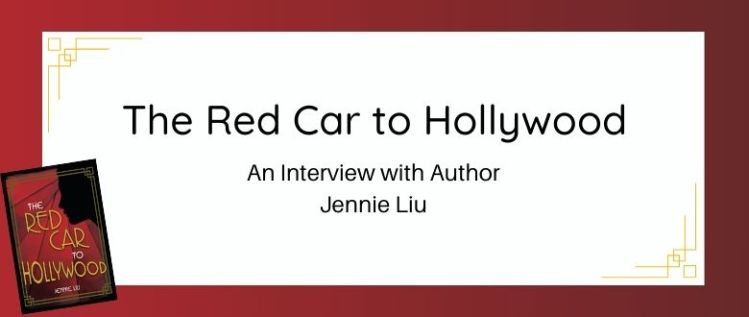
Step into the vibrant, drama-filled era of early Hollywood in The Red Car to Hollywood, where 16-year-old Ruby Chan is in a tough spot following the revelation of her secret relationship with a white boy to her traditional Chinese parents. Her parents hire a matchmaker in an effort to protect their reputation, but Ruby is determined to thwart their plans. She befriends 19-year-old film star Anna May Wong, who defies Chinese conventions and challenges stereotypes. Inspired by Anna May, Ruby seeks to forge her own path amidst danger and betrayal while discovering how others perceive her and how she sees herself.
Today author Jennie Liu joins us to delve into the inspirations behind the book, spotlight her main characters, and explore the challenges of writing and research during the pandemic. Keep reading to download the free discussion guide!

What was your inspiration for the book?
In the spring of 2020, calls to Asian hate connected to COVID-19 were making me absolutely furious. The trend of targeting immigrants was especially repellant because, except for Indigenous Americans, everyone here has a family history of immigration or transplantation. I hadn’t previously written an immigration or assimilation story because I’d already read so many books with that focus. But during the pandemic I felt moved to write something in that direction.
Around the same time, I watched the Netflix alternate-history series Hollywood, in which the real-life Chinese American actor Anna May Wong wins an Oscar. In reality, despite being critically acclaimed for her acting skills, AMW was relegated to the sidelines because of racism. I’d first learned about AMW in Lisa See’s nonfiction book On Gold Mountain, which covered early Chinese immigrants’ experiences, their contributions to the US, the racism they endured, and the melding of cultures over the generations. I decided to zone in on a story about second-generationers, kids who are often caught between two worlds. I especially wanted to focus on young women. Several years ago, I was invited to do a book talk at a Chinese heritage camp for adoptees. The organizers asked me to share any ideas I had for discussion topics. One topic I half-jokingly suggested was “Asian Fetishization: It’s a Very Real Thing.” At the time I wasn’t actually prepared to research and develop a whole talk about this. But in writing The Red Car to Hollywood, I’ve learned so much about how the objectification of Asian women and the intersection of racism and sexism is rooted in early Chinese American history and perpetuated in Hollywood through stereotyping.
Anna May Wong is a secondary character in The Red Car to Hollywood. Can you tell us about her?
Anna May Wong is generally considered the first Chinese American movie star. She was born in Los Angeles in 1905 to a laundryman and his second wife. (To give you an idea of the times, her father actually had another family in China.) Los Angeles was emerging as the global center of the film industry, and movies were being filmed all over town, including in Chinatown. Anna May Wong started hanging around shoots at a very young age and became known as CCC, “curious Chinese child,” by the crews and actors. She began working as an extra, which led to bigger parts—but the only roles generally available to Asians were subservient, stereotypical characters. Leading roles, even if they called for Asian characters, went to white actors who played them in yellowface. AMW did make a name for herself as a very skilled actor, but she got tired of being typecast in supporting roles. She moved to Europe for a couple of years, where she became quite a sensation.
By the time she returned to the States in 1930s, she was an international celebrity. But Hollywood continued to pass her over for prime parts. She was given a star on the Hollywood Walk of Fame in 1960. And in 1961, at age 56, she was set to play a leading role with an all-Asian cast in the film production of Rogers and Hammerstein’s Flower Drum Song, but she died just a few weeks before shooting was scheduled to start. In recent years, she’s been more widely recognized for her tenacity and grace despite the racism and constraints she faced. Now her image is circulating on quarters through the American Women’s Quarter’s Program, and there’s an Anna May Wong Barbie doll.
Why did you choose not to make Anna May Wong the main character of the story?
A couple of reasons. Early in the pandemic my research was constrained by lockdown, and I wasn’t finding much information about Anna May Wong’s teenage years—aside from her entanglements with older men. I felt that this could easily dominate any story about that period of her life, and I really didn’t want to write a story that focused on that. But I was struck by how bold, outgoing, and friendly young AMW was; how she made mistakes and got into messy situations like most teenagers; and how she juggled being both American and Chinese, doing what she wanted to do but respecting her background. So, although the traditional Chinese community was judgmental of her, surely her peers in the younger generation would’ve thought she was something! There were so few Chinese American girls in LA at the time, and I was curious about what these girls were like. So I decided my main character would be an “ordinary” girl rather than a famous historical figure.
Can you talk about the main character, Ruby?
Ruby is an American-born Chinese, second-generation girl with a foot in two worlds, facing the challenge of having traditional parents yet feeling very American. You’d think that a girl growing up in 1920s Chinatown might be insulated and reserved, and yes, there were girls like that, but Anna May Wong and other young Chinese American women I read about broke that mold. I wanted to create a character who pushed back on the idea of the demure “model minority.” Ruby has impulses, can be reactive, and makes mistakes. I wanted her to feel like a fully formed person, not a particular “representation” of a group.
What was the research process for the book?
It was difficult during the early pandemic; travel was out of the question, so I couldn’t access a lot of primary sources. Even many of the libraries I reached out to in 2020 seemed to be closed. So I mostly bought books online and went through online library archives to view digitized materials, like old movie magazines. I got very taken with the history of LA, Old Chinatown, early silent movie-era Hollywood, and daily life in the 1920s, so those interests began to direct my story. I admit I went down too many rabbit holes! In 2021 and 2022 I was able to connect online with librarians who answered some of my questions and helped me track down maps and articles about California history, Chinatown, the Pacific Electric Railway (the Red Cars), and Anna May Wong. I was also able to get in touch with AMW biographer Katie Gee Salisbury, who shared some articles with me and let me have an early peek at her book, Not Your China Doll: The Wild and Shimmering Life of Anna May Wong.
What do you hope readers will discover from reading the book?
I hope young readers see both the struggle and richness of what it’s like to straddle two worlds. The struggle may be pretty obvious, but the teen years are often when you begin to more fully recognize the value of your culture and your differences.
Praise for The Red Car to Hollywood
★”Meticulously researched and sumptuously realized, Ruby’s story captures the time when women were swiftly gaining ground in all parts of society whilst burdened by old structures dragging them down. . . Readers will be inspired by Ruby’s resilience and dazzled by the historical setting that Liu has painstakingly recreated.”—starred, Booklist
“Ruby’s determination and pride in her cultural heritage are easy to root for, and her narrative closes on a satisfying note.”—Kirkus Reviews
“Centering female perspectives—such as Ruby’s ruminations on her mother’s own marriage, her witnessing Anna’s attempts to break Hollywood glass ceilings, and her recovering from sexual assault at the hands of a powerful individual—serves to showcase myriad additional challenges posed against Chinese American women in a narrative that expertly captures a complex historical moment.”—Publishers Weekly
“In addition to young love, friendships, and relationships, this book also discusses racism and sexism and ways to find self-identity that meets pride of culture. Recommended for collection gaps about the racism that Chinese Americans faced back in 1920s, and the different perspectives and approaches to assimilation between the first- and second-generation immigrants.”—School Library Journal
Free Educator Resources
Download the discussion guide to accompany reading and encourage critical thinking in the classroom!
Connect with the Author

Jennie Liu is the daughter of Chinese immigrants. She has been fascinated by the attitudes, social policies, and changes in China each time she visits. Her young adult novels have won honors including a Freeman Book Award Honorable Mention and an In the Margins: Best Books for Teens award. She lives in North Carolina with her family.

Comments