Dreams to Ashes: An Interview with Author Livia Blackburne and Illustrator Nicole Xu
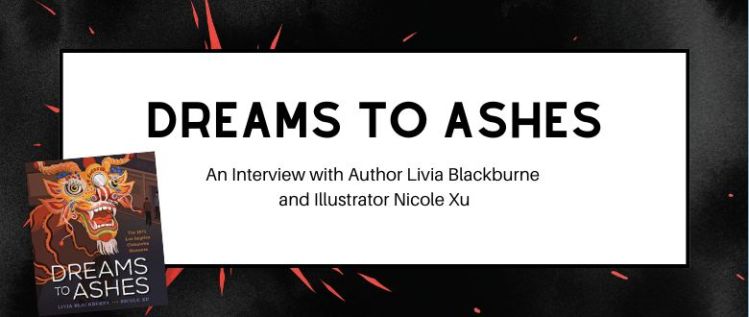
Dreams to Ashes: The 1871 Los Angeles Chinatown Massacre is a powerful nonfiction picture book full of both heartbreak and hope. In the late 1800s LA was more small town than city, with a total population under six thousand. Newspapers routinely published anti-Chinese rhetoric, and when a conflict broke out between two mutual aid societies, a mob gathered in response. The ensuing overnight massacre left eighteen Chinese men dead as their dreams for their future turned to ashes.
New York Times bestselling author Livia Blackburne and illustrator Nicole Xu bring this essential moment in American history to picture book readers. Today both are here to share their experience crafting the story for a young audience.

From Author Livia Blackburne
What inspired you to write the book?
I think I first learned about the Los Angeles Massacre through an NPR feature. Given that this was one of the largest mass lynchings in US history, I was shocked that I’d never heard about it, especially since I was a Chinese person living in Los Angeles. This was during the Covid lockdowns, when anti-Asian rhetoric and violence was on the rise, so I thought it was important to shine light on this previous period in history when anti-Asian rhetoric led to tragic violence, in hope that it would cause people to think more critically about what was happening in the present.
What surprised you most while researching the book?
This might sound naïve given that I made the choice to write and research a massacre book, but what surprised me most was the extent of the cruelty and violence that occurred. I was especially struck by how some perpetrators seemed to enjoy the violence, based on eyewitness accounts. It became very clear to me that the Chinese population in Los Angeles had been greatly dehumanized in the eyes of their fellow citizens, which enabled some of the more vicious actions taken that night.

What were some challenges you faced while writing?
The biggest challenge was figuring out how to speak about such a dark topic in an age-appropriate manner. We did this by being more abstract than concrete about the violence in both the writing and the art. I wanted to focus on the social and cultural forces that led to the massacre, and I wanted to place the massacre and its aftereffects in an overall historical context. This was more important to me than delving into the details of the event itself.
What are some resources for people wanting to learn more about the topic?
The Chinatown War by Scott Zesch chronicles the events leading up to and surrounding the massacre in great detail. I found it to be a really helpful when researching for my book.
What do you hope that people take away from the book?
I’d like for people to come away with an understanding of how dangerous hateful rhetoric and discrimination can be to society. And I hope this understanding will inspire people to stand up against hate and advocate for the marginalized in our communities.

From Illustrator Nicole Xu
Please describe your artistic process and the medium that you used to create your illustrations.
To start, I like creating sketches digitally on my iPad using Procreate. I sketch in a very painterly fashion where I directly use color to establish the mood and use large shapes to establish a composition. From there, I refine the shapes until they resemble the idea I had envisioned in my head. For the final art, I like using black ink to create large swatches of texture that match the composition of the sketches. I then scan in the pages, add in color, and digitally paint over the piece until it’s complete. I love the looseness of using ink painting, but the control that the digital medium offers is hard to beat.
What did you most enjoy about illustrating Dreams to Ashes?
Illustrating this book has made me more aware of the history of Chinese-Americans and I’m glad that I’ve had this opportunity to gain more knowledge about my culture. I read extensively about the LA Massacre while working on the project, and was perturbed that I, as a Chinese-Canadian now living in America, was not educated about the event sooner. I’m happy to not only learn more myself, but to be able to help others comprehend the tragedy in the future.

How did you choose the style you used to illustrate this book?
I frequently work on projects that explore grief and healing, so I didn’t have to stray too far from my usual work. The main difference is that I had to heavily reference many photographs of places, people, clothing, and maps in order to create the illustrations, while outside of this project, I would normally draw more abstract depictions of emotions.
What were some of the biggest challenges you faced illustrating this book?
One of the hardest parts of illustrating Dreams to Ashes is maintaining a balance of somber moments and uplifting moments. I wanted to highlight happiness, humanity and hope throughout the telling of a terrible tragedy.
Another challenge of illustrating this book is largely due to my terrible sense of direction. It took an embarrassingly long time to make sense of the environment in my head to make sure the backgrounds were accurately portrayed.

What is your creative process when working with a manuscript?
I’ve loved reading ever since I was a child because in my mind, as I read, flashes of imagery would appear like a disjointed movie. One of my favorite parts of creating is the initial moments where all I’m doing is splashing some color on a canvas to establish the mood of a page. A serene moment would be blue, maybe some pink, a stressful moment might be a vibrant blue, violence, of course, red. Eventually I’ll move onto the more practical elements and pinpoint the essence of the text and add in the who, what and where. Working on a book is fun because you get to repeat visuals on multiple pages to tie the book together, such as the oranges or newspaper motifs.
Praise for Dreams to Ashes
★ “Meticulously researched and beautifully illustrated in full-color drawings . . . the story acknowledges the growing pains of pushing out of communities (Indigenous and other immigrant communities) by the Spanish colonial missions and later by Americans to make room for Western development . . . This deeply felt coverage of the inflection points for so many communities is a must-have for all libraries.” — starred, School Library Journal
“Deftly brings to light a lesser-known horror in the context of America’s history of racism against Chinese immigrants.” — Kirkus Reviews
“In this ruminative account of a lesser-known race riot that left 18 immigrants dead, Blackburne poses big, still cogent questions.” — Booklist
“Fire-oriented metaphors that hint at the coming conflagration describe growing tensions, while Xu’s thick-lined ink and digital media illustrations incorporate images of fire, smoke, and sparks.” — Publishers Weekly
Connect with the creators

Livia Blackburne is a Chinese American writer who penned her first novel while researching the neuroscience of reading at the Massachusetts Institute of Technology. She now writes full-time and is the author of several books including Midnight Thief (An Indies Introduce New Voices selection) and Feather & Flame (in Disney’s Queen’s Council series), as well as the picture book I Dream of Popo, which received starred reviews from Publisher’s Weekly and Kirkus. She is based in California.
Photo Credit: A Pocket of Time Photography

Nicole Xu is an artist who was born in Shanghai, grew up in Vancouver, Canada, and is now based in Portland, Oregon. She graduated from Rhode Island School of Design with a BFA in illustration and has worked with numerous magazine and publishing clients. Her work often explores themes of loss, healing, and empathy. Her debut picture book, All of A Sudden and Forever, Help and Healing after the Oklahoma City Bombing, written by Chris Barton, received two starred reviews and was an Orbis Pictus Recommended Book.
Photo Credit: Laura Thompson

Comments